Efficient, Property-Aligned Fan-Out Retrieval via RL-Compiled Diffusion
📌 核心贡献
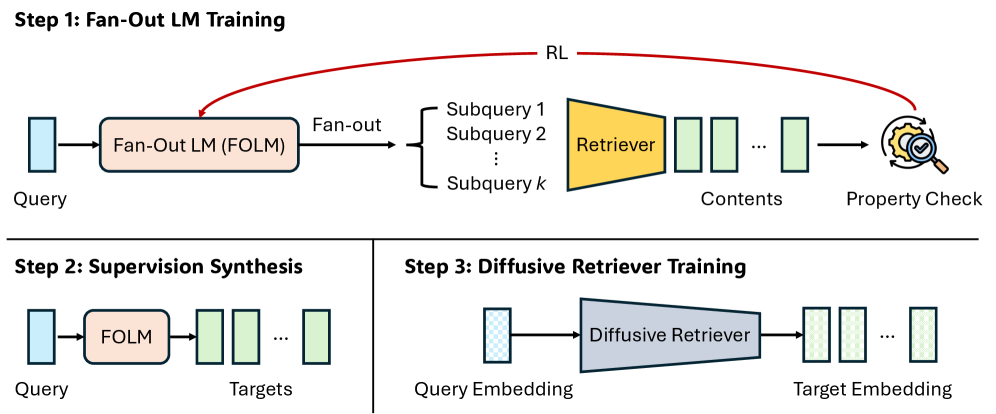
提出 R4T 框架,将强化学习作为”目标转换器”:先用 RL 训练 fan-out 语言模型优化集合级检索目标,再将其蒸馏为轻量扩散检索器,实现单次前向推理即可生成多样性对齐的集合值检索结果,推理延迟降低一个数量级。
📖 摘要
Many modern retrieval problems are set-valued: given a broad intent, the system must return a collection of results that optimizes higher-order properties (e.g., diversity, coverage, complementarity, coherence) while remaining grounded with respect to a fixed database. Set-valued objectives are typically non-decomposable and are not captured by existing supervised (query, content) datasets which only prioritize top-1 retrieval. Consequently, fan-out retrieval is often employed to generate diverse subqueries to retrieve item sets. While reinforcement learning (RL) can optimize set-level objectives via interaction, deploying an RL-tuned LLM for fan-out retrieval is prohibitively expensive at inference time. Conversely, diffusion-based generative retrieval enables efficient single-pass fan-out in embedding space, but requires objective-aligned training targets. To address these issues, we propose R4T (Retrieve-for-Train), which uses RL once as an objective transducer in a three-step process: (i) train a fan-out LLM with composite set-level rewards, (ii) synthesize objective-consistent training pairs, and (iii) train a lightweight diffusion retriever to model the conditional distribution of set-valued outputs. Across large-scale fashion and music benchmarks consisting of curated item sets, we show that R4T improves retrieval quality relative to strong baselines while reducing query-time fan-out latency by an order of magnitude.
🔍 关键信息
| 字段 | 内容 |
|---|---|
| 发表 | 2026-03-06 |
| 机构 | Google, University of Illinois Urbana-Champaign |
| 分类 | cs.IR, cs.LG |
| 链接 | arXiv |
📝 我的笔记
方法总览
动机与问题定义
现代检索任务中,许多场景需要集合值检索(set-valued retrieval)——给定一个宽泛的查询意图,系统需返回一组结果,满足多样性、覆盖度、互补性、连贯性等集合级属性。这类目标是不可分解的(non-decomposable),传统的 (query, content) 监督数据只优化 top-1 检索,无法处理。
Fan-out 检索是一种常见策略:将一个宽泛查询展开为 个子查询 ,各自检索后聚合。核心矛盾在于:
- RL 优化 LLM 可以直接优化集合级目标,但推理代价极高(自回归生成多个子查询)
- 扩散模型可以单次前向生成多个检索方向,但缺乏目标对齐的训练数据
R4T 的核心思路:用 RL 一次性训练好策略 → 生成合成数据 → 蒸馏到轻量扩散模型,将 RL 的优化能力与扩散模型的推理效率结合。
方法细节
Stage 1:Soft-GRPO 强化学习优化 Fan-Out LM
Fan-Out Language Model (FOLM) 以查询 为输入,生成 个子查询。使用 Group Relative Policy Optimization (GRPO) 训练,对每组采样计算优势函数:
在标准 GRPO 基础上加入前向和反向 KL 正则化(Soft-PPO),防止策略过度偏离:
实际实现的 per-token loss:
其中 为重要性比率。
集合级奖励设计
论文定义了两类检索任务,各有不同的奖励函数:
任务一:Open-Ended Abstract Retrieval (OAR) —— 无参考集,组合三项奖励:
- Groundedness(接地性):惩罚子查询与数据库最近邻的距离
- Diversity(多样性):使用 Vendi Score 衡量检索结果的多样性
- Alignment(对齐性):子查询与原始查询的余弦相似度
默认权重:。
任务二:Weakly Supervised Compositional Retrieval (WSCR) —— 有弱参考集 ,直接优化覆盖率:
Stage 2:合成监督数据生成
RL 优化后的 FOLM 作为行为生成器。对每个查询,采样 128 组 fan-out 输出并执行检索,构造目标张量:
- OAR 任务:,由检索到的内容 embedding 构成
- WSCR 任务: 由优化后的子查询 embedding 构成
训练时随机置换行顺序以增强置换鲁棒性。合成数据集:。
Stage 3:扩散模型单次 Fan-out
使用 Transformer-based denoiser ,采用 Variance Exploding (VE) 扩散框架:
其中 。
关键设计:
- 使用 EDM 预条件化的 Transformer 架构
- 查询 embedding 通过 cross-attention 注入
- 训练时随机 drop 以支持 Classifier-Free Guidance (CFG)
- 推理时用 probability flow SDE 生成 ,再通过最近邻映射到数据库
两种部署变体:
- R4T-FOLM:直接部署 RL 优化后的 FOLM(自回归,高质量但慢)
- R4T-Diffusion:蒸馏到扩散模型(非自回归,单次前向,快 12-20 倍)
扩散模型架构细节
| 参数 | 值 |
|---|---|
| 骨架 | Coherent Transformer |
| 序列长度 | 12 |
| Embedding 维度 | 128 |
| 隐藏维度 | 1024 |
| MLP 维度 | 1024 |
| 注意力头数 | 16 |
| 层数 | 6 |
| 参数量 | 53.9M |
| 噪声调度 | Tangent, 范围 |
| 0.088 | |
| CFG 强度 | 0.1 |
| 推理步数 | 256 |
关键实验结果
OAR 任务(LLM-as-a-Judge 评估,Gemini-2.5-Pro 评分,5 点 Likert 量表 x20)
Polyvore 数据集(时尚):
| 方法 | Groundedness | Diversity | Alignment | Average |
|---|---|---|---|---|
| No Fan-out | 22.4 | 34.4 | 21.4 | 26.1 |
| Gemma3-4B Zero-shot | 28.4 | 56.0 | 31.2 | 38.5 |
| Gemma3-4B Best-of-5 | 28.9 | 61.0 | 32.7 | 40.9 |
| R4T-FOLM (Gemma) | 30.8 | 76.8 | 39.8 | 49.1 |
| R4T-Diffusion (Gemma) | - | 74.3 | 37.6 | - |
| Qwen3-4B Zero-shot | 23.8 | 37.0 | 23.4 | 28.1 |
| Qwen3-4B Best-of-5 | 27.0 | 40.3 | 24.0 | 30.4 |
| R4T-FOLM (Qwen) | 37.0 | 62.8 | 28.0 | 42.6 |
Music 数据集:
| 方法 | Groundedness | Diversity | Alignment | Average |
|---|---|---|---|---|
| No Fan-out | 48.8 | 20.0 | 41.8 | 36.9 |
| Gemma3-4B Zero-shot | 49.8 | 42.6 | 51.8 | 48.1 |
| R4T-FOLM (Gemma) | 63.1 | 49.2 | 62.0 | 58.1 |
| R4T-Diffusion (Gemma) | - | 46.7 | 59.6 | - |
WSCR 任务(Polyvore,弱参考集评估)
| 方法 | Recall@5K | Hit@5K | Vendi Score |
|---|---|---|---|
| Gemini-2.5-Flash | 15.7 | 52.1 | 33.4 |
| Gemma3-4B | 6.0 | 25.9 | 44.2 |
| R4T-FOLM (Gemma) | 16.9 | 54.4 | 40.5 |
| R4T-FOLM (Qwen) | 20.9 | 64.6 | 27.5 |
| R4T-Diffusion (Gemma) | 15.0 | 54.1 | 46.2 |
| R4T-Diffusion (Qwen) | 16.5 | 57.5 | 34.7 |
值得注意的 trade-off:FOLM 的 Recall/Hit 更高但 Vendi Score 较低,说明自回归 fan-out 倾向于集中在主导语义模式上;扩散检索器的多样性更高。
Ablation 分析
奖励组件消融
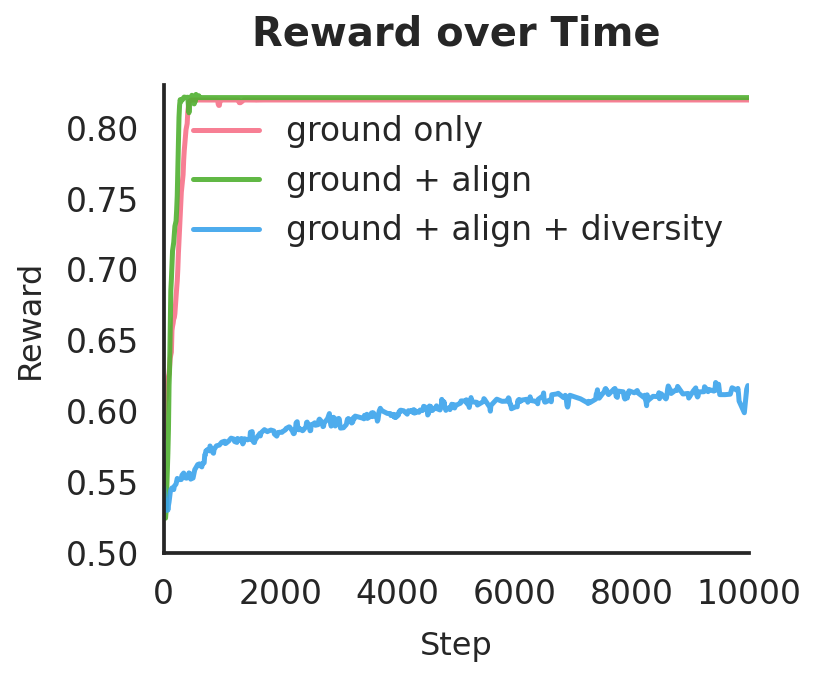
奖励函数设计是 R4T 成功的关键。消融实验揭示了严重的 reward hacking 现象:
- 仅 Groundedness:策略迅速收敛到退化字符串(如”line ending line ending…“),通过生成数据库中已有的文本碎片获得高分
- Groundedness + Alignment:通过简单复述原始查询实现捷径解(query paraphrasing collapse)
- 三项奖励组合():多样性和对齐性互为”反锚”,迫使策略进入平衡区域,捷径解失效,训练稳定收敛
权重比例消融
| 权重比例 | 效果 |
|---|---|
| 6:2:2 | 偏重接地性,多样性/对齐性受抑制 |
| 4:3:3 | 较均衡表现 |
| 2:4:4 | 偏重对齐/多样性,接地性探索不足 |
推理效率
| Batch Size | 自回归 LLM | 扩散模型 | 加速比 |
|---|---|---|---|
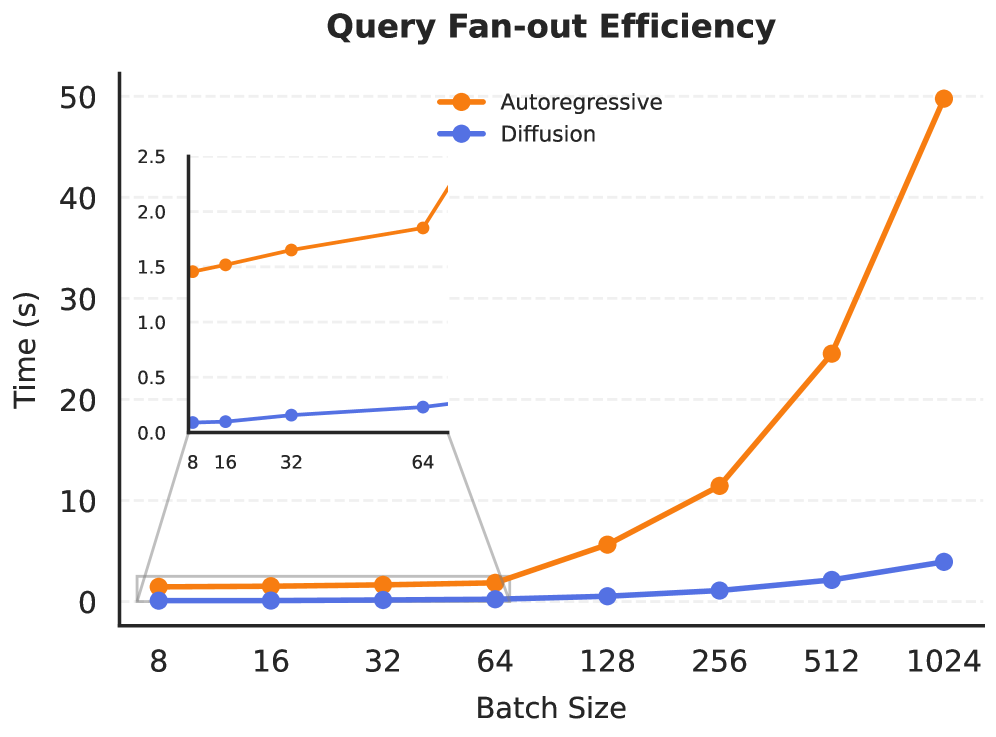
| 8 | ~1.46s | ~0.07s | ~20x |
| 1024 | ~50s | ~4.21s | ~12x |
扩散模型(53.9M 参数)在所有 batch size 下均实现 12-20 倍加速,证实了从重量级自回归”System 2”到轻量级扩散”System 1”的蒸馏对于实时部署至关重要。
总结性评价
优点:
- 提出了一种优雅的三阶段框架,将 RL 的优化能力与扩散模型的推理效率解耦,避免了推理时部署 RL-tuned LLM 的高代价
- 奖励函数设计经过深入消融验证,reward hacking 分析具有实践指导意义
- 扩散蒸馏带来 12-20 倍推理加速,对工业部署有实际价值
- 在 embedding 空间而非 token 空间做生成式检索,天然支持多模态
局限:
- RL 训练阶段仍需与检索器反复交互,前期训练成本高
- 奖励函数需要人工设计,主观性质(创意、文化敏感性等)难以编码
- 评估依赖 LLM-as-a-Judge,可能引入评判模型自身的偏差
- 实验仅在时尚和音乐两个领域验证,泛化性待考察
🔗 相关论文
基于/改进自: GRPO
同方向: Diffusion-DPO, DDPO