FIPO: Eliciting Deep Reasoning with Future-KL Influenced Policy Optimization
📌 核心贡献
用折扣未来 KL 散度为每个 token 计算细粒度优势权重,取代 GRPO 的均匀奖励分配,在无需 critic 模型的情况下实现 PPO 级别的密集信用分配,突破推理链长度瓶颈。
📄 Abstract
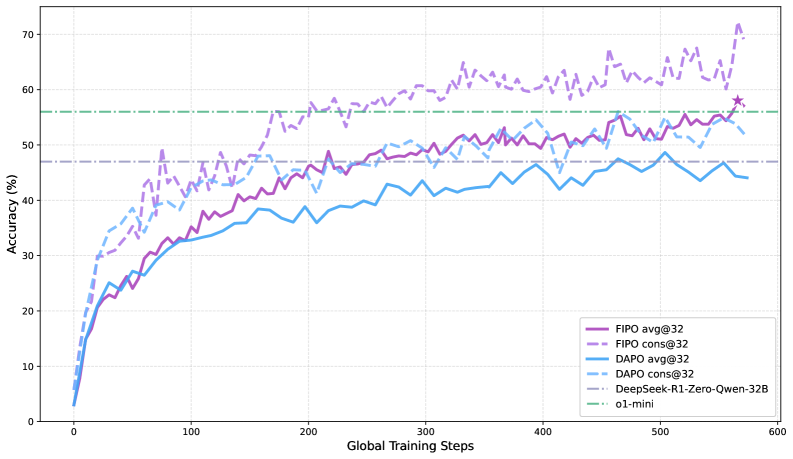
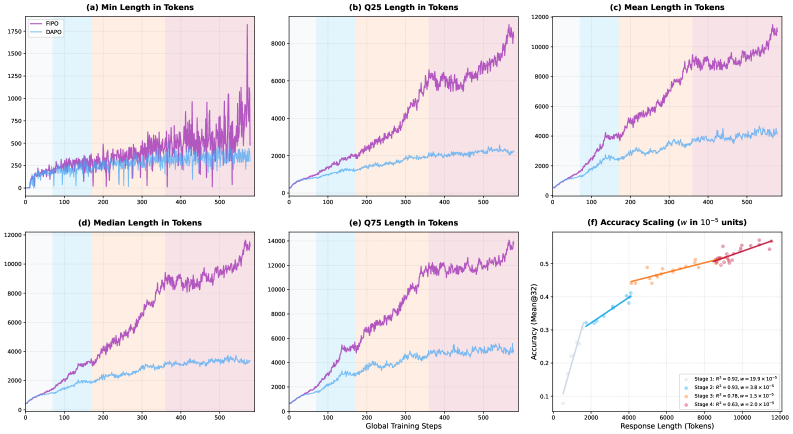
We present Future-KL Influenced Policy Optimization (FIPO), a reinforcement learning algorithm designed to overcome reasoning bottlenecks in large language models. While GRPO style training scales effectively, it typically relies on outcome-based rewards (ORM) that distribute a global advantage uniformly across every token in a trajectory. We argue that this coarse-grained credit assignment imposes a performance ceiling by failing to distinguish critical logical pivots from trivial tokens. FIPO addresses this by incorporating discounted future-KL divergence into the policy update, creating a dense advantage formulation that re-weights tokens based on their influence on subsequent trajectory behavior. Empirically, FIPO enables models to break through the length stagnation seen in standard baselines. Evaluated on Qwen2.5-32B, FIPO extends the average chain-of-thought length from roughly 4,000 to over 10,000 tokens and increases AIME 2024 Pass@1 accuracy from 50.0% to a peak of 58.0% (converging at approximately 56.0%).
📝 我的笔记
方法总览
核心问题与动机
GRPO/DAPO 的根本缺陷:均匀信用分配(Uniform Credit Assignment)
GRPO 中所有 token 共享同一个 scalar advantage:
- 关键逻辑转折点与无意义填充词被同等对待
- 模型无法学到”哪步推理真正重要”
- 推理链长度在训练中途陷入停滞(length stagnation)
方法:FIPO 三步走
Step 1:概率偏移(Probability Shift)
- 正偏移:当前策略正在强化这步推理
- 负偏移:当前策略正在抑制这步推理
Step 2:Future-KL + Soft Decay Window
- 语义:token 对后续整条轨迹概率分布的累积影响
- 折扣因子 :越远影响越小()
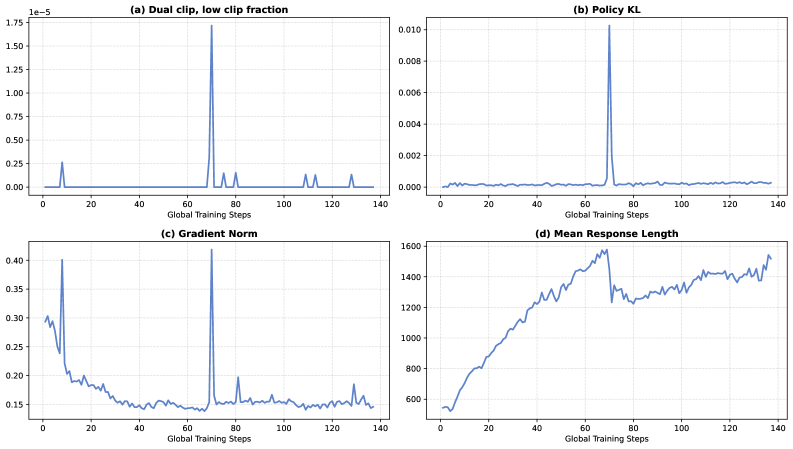
- Mask :过滤超过 Dual-Clip 阈值的 token,防止梯度爆炸
Step 3:重加权 Advantage + Clipping
- → → 放大正 advantage,加重负 advantage 惩罚
- → → 减小梯度,防止过度惩罚
最终目标函数:
关键结果
| Method | AIME 2024 Avg@32 | AIME 2024 Cons@32 | AIME 2025 Avg@32 |
|---|---|---|---|
| DAPO | 50.0% | 60.0% | 38.0% |
| FIPO | 56.0% | 73.0% | 43.0% |
- CoT 长度:DAPO ~4k → FIPO >10k tokens
- 超越 DeepSeek-R1-Zero-32B(~47%)和 o1-mini(~56%)
训练配置
- 基座:Qwen2.5-32B-Base
- 数据:DAPO-17K(公开)
- 框架:verl(已开源)
- FutureKL 参数:,weight clipped to
- mini-batch:1024 samples(更大 batch 提升稳定性)
深度评价
FIPO 本质是在解决 temporal credit assignment 问题,但不需要 PPO 的 critic 网络。Future-KL 的直觉是:用新旧策略在后续轨迹上的 KL 偏移来衡量当前 token 的因果影响力——影响越大,越值得被强化或纠正。
思路来源于作者组两篇前驱工作:
- 是推理改善的鲁棒指标(Huang et al., 2025)
- 少量”稀疏但关键”的 token 主导推理走向(Meng et al., 2025)
FIPO 填补了 GRPO(高效粗糙)和 PPO(精细昂贵)之间的空白,是 RLVR 领域的重要进展。
局限: Pass@32 提升有限(RL 挖潜力 vs 扩知识边界);超参调优细节有待更多消融;仅在 32B 验证。
🔗 相关工作
同方向: DAPO, GRPO, DeepSeek-R1