CLIPScore
📌 核心贡献
首次证明预训练的 CLIP 模型可以直接用于无参考文本(reference-free)的图像描述质量评估,提出的 CLIPScore 在与人类判断的相关性上超越了所有传统基于参考文本的指标(CIDEr、SPICE 等),为后续所有基于 CLIP 的图像奖励模型(ImageReward、PickScore、HPS)奠定了基础。
📖 摘要
Image captioning has conventionally relied on reference-based automatic evaluations, where machine captions are compared against captions written by humans. This is in contrast to the reference-free manner in which humans assess caption quality. In this paper, we report the surprising empirical finding that CLIP (Radford et al., 2021), a cross-modal model pretrained on 400M image+caption pairs from the web, can be used for robust automatic evaluation of image captioning without the need for references. Experiments spanning several corpora demonstrate that our new reference-free metric, CLIPScore, achieves the highest correlation with human judgements, outperforming existing reference-based metrics like CIDEr and SPICE. Information gain experiments demonstrate that CLIPScore, with its tight focus on image-text compatibility, is complementary to existing reference-based metrics that emphasize text-text similarities. Thus, we also present a reference-augmented version, RefCLIPScore, which achieves even higher correlation. Beyond literal description tasks, several case studies reveal domains where CLIPScore performs well (clip-art images, alt-text rating), but also where it is relatively weaker in comparison to reference-based metrics, e.g., news captions that require richer contextual knowledge.
🔍 关键信息
| 字段 | 内容 |
|---|---|
| 机构 | Allen Institute for AI (AI2), University of Washington |
| 发表 | 2021-04-18 (EMNLP 2021) |
| 分类 | cs.CV, cs.CL |
| 链接 | arXiv |
📝 我的笔记
方法总览
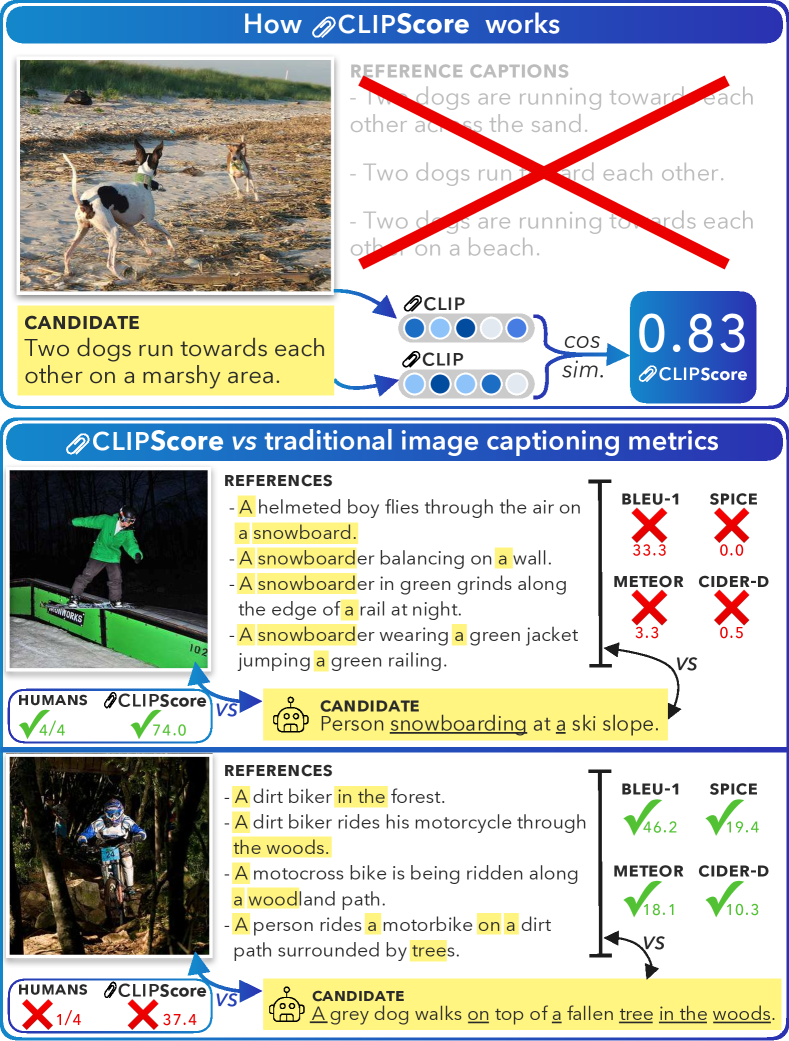
动机与问题定义
传统图像描述评估指标(BLEU、METEOR、CIDEr、SPICE)都依赖人工撰写的参考描述(reference captions),通过比较候选描述与参考描述的文本相似度来打分。这种方式存在两个核心问题:
- 与人类评估方式不一致:人类评估图像描述质量时,直接看图片和描述文本,不需要参考文本
- 参考文本的局限性:参考文本收集成本高,且即使有多条参考文本,n-gram 匹配仍然不够充分 — 好的描述可能使用全新的词汇(被惩罚),而差的描述可能恰好使用了常见词汇(被奖励)
本文的核心假设:CLIP 在 400M 图文对上的预训练使其学到了强大的图文对齐能力,可以直接用来评估图像描述质量。
CLIPScore(CLIP-S)
使用 CLIP ViT-B/32 模型,分别提取图像和文本的嵌入向量,计算余弦相似度:
其中:
- 为候选描述的 CLIP 文本嵌入(前缀 “A photo depicts” 可略微提升效果)
- 为图像的 CLIP 视觉嵌入
- 为缩放因子,将分数分布从 拉伸到
- 截断负值(实际中未观察到负余弦相似度)
关键特点:完全不需要参考文本,只需要图像和候选描述。
RefCLIPScore(RefCLIP-S)
当参考文本可用时,可以通过调和平均数(harmonic mean)将 CLIP-S 与参考文本信息结合:
其中 是所有参考文本的 CLIP 文本嵌入集合。RefCLIPScore 同时捕捉了图文兼容性(image-text)和文文相似性(text-text),在所有实验中都进一步提升了性能。
关键实验结果
Flickr8K-Expert(Kendall 相关性)
| 指标 | 是否需要参考 | |
|---|---|---|
| BLEU-1 | 32.3 | 是 |
| BLEU-4 | 30.8 | 是 |
| METEOR | 41.8 | 是 |
| CIDEr | 43.9 | 是 |
| SPICE | 44.9 | 是 |
| ViLBERTScore-F | 50.1 | 是 |
| CLIP-S (no refs) | 51.2 | 否 |
| RefCLIP-S | 53.0 | 是 |
Flickr8K-CF(Kendall 相关性)
| 指标 | 是否需要参考 | |
|---|---|---|
| BLEU-4 | 16.9 | 是 |
| CIDEr | 24.6 | 是 |
| SPICE | 24.4 | 是 |
| CLIP-S (no refs) | 34.4 | 否 |
| RefCLIP-S | 36.4 | 是 |
Composite(Kendall 相关性)
| 指标 | 是否需要参考 | |
|---|---|---|
| BLEU-4 | 30.6 | 是 |
| CIDEr | 37.7 | 是 |
| SPICE | 40.3 | 是 |
| ViLBERTScore-F | 52.4 | 是 |
| CLIP-S (no refs) | 53.8 | 否 |
| RefCLIP-S | 55.4 | 是 |
Pascal-50S 成对排序准确率
| 指标 | HC | HI | HM | MM | Mean |
|---|---|---|---|---|---|
| BLEU-4 | 60.4 | 90.6 | 84.9 | 54.7 | 72.6 |
| CIDEr | 65.1 | 98.1 | 90.5 | 64.8 | 79.6 |
| CLIP-S (no refs) | 56.5 | 99.3 | 96.4 | 70.4 | 80.7 |
| RefCLIP-S | 64.5 | 99.6 | 95.4 | 72.8 | 83.1 |
信息增益分析
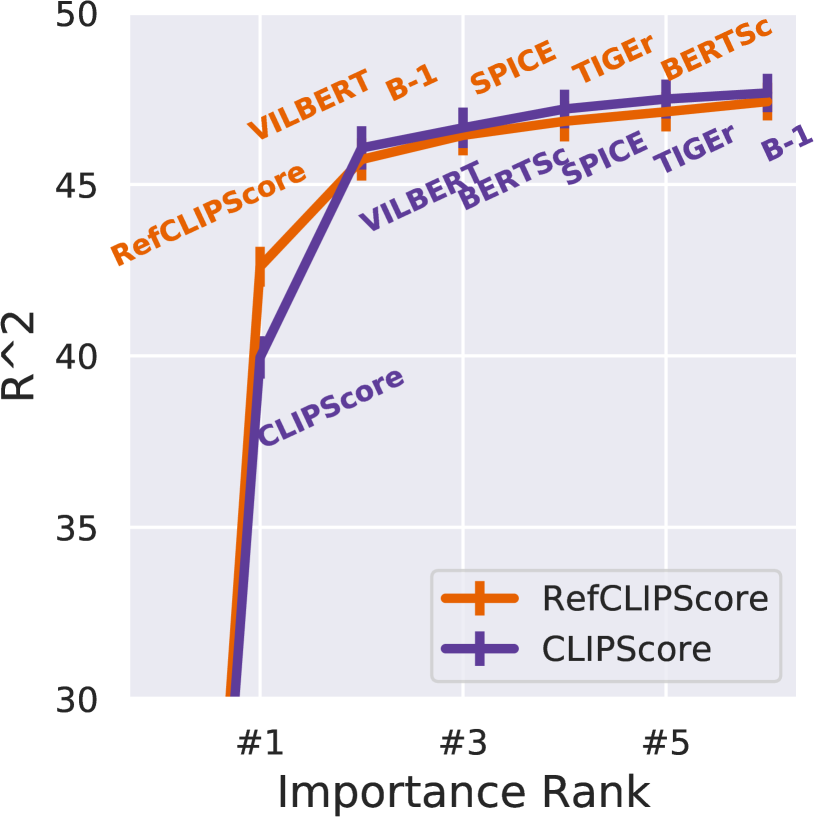
通过前向选择回归实验(forward-selection),作者发现:
- CLIP-S(或 RefCLIP-S)总是最先被选中的指标,说明它包含的信息量最大
- CLIP-S 与传统指标(BLEU、CIDEr、SPICE)以及新指标(ViLBERTScore-F)是互补的
- 推荐的最小指标组合:至少一个 image-aware 指标(如 CLIP-S)+ 一个强参考指标(如 SPICE)
对幻觉的敏感性
在 FOIL 数据集(将正确描述中的一个名词替换为看似合理但错误的词)上测试:
- CLIP-S 无需参考文本即可达到 87.2% 的检测准确率
- RefCLIP-S 达到 91.0%(1-ref)和 92.6%(4-ref)
- 传统指标在少参考文本时性能显著下降(如 BLEU-4 从 82.6% 降到 66.5%),但 CLIP-S 始终稳定
案例分析
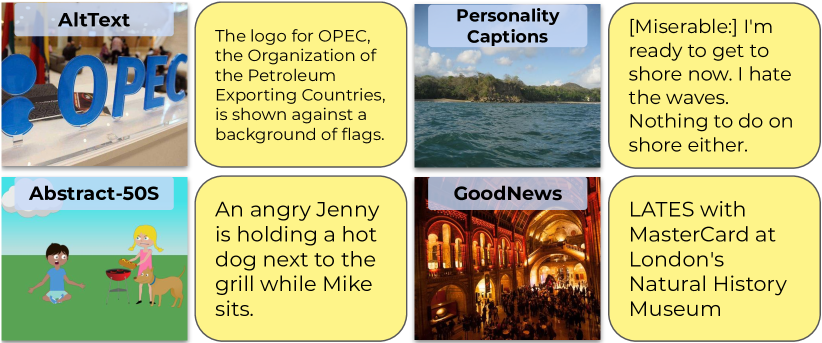
| 领域 | CLIP-S 表现 | 说明 |
|---|---|---|
| Alt-Text (Twitter) | 好 ( = 48.4) | 参考指标因推文噪声表现差 |
| Abstract-50S (剪贴画) | 中等 (68) | 虽不及参考指标 (79),但远超基线 (53) |
| Personality Captions | 差 | 偏好字面描述,无法判断 “engaging” |
| News Captions | 差 (65) | 需要上下文知识(人名、地点、事件) |
对后续工作的影响
CLIPScore 是所有基于 CLIP 的图像评估/奖励模型的先驱:
- ImageReward (2023):在 CLIP 基础上加入人类偏好标注数据的有监督训练,从 “图文匹配度” 扩展到 “生成质量偏好”
- PickScore (2023):用 Pick-a-Pic 数据集微调 CLIP,专注于 T2I 生成的人类偏好预测
- HPS / HPSv2 (2023):Human Preference Score,同样基于 CLIP 微调但使用不同的偏好数据
CLIPScore 证明了 CLIP 嵌入空间天然包含了与人类判断高度相关的图文质量信号,后续工作本质上都是在此基础上引入更精细的人类偏好监督。
局限性
- 无法捕捉细粒度质量差异:CLIP-S 主要衡量图文语义匹配度,对图像生成质量(如真实感、美学、细节一致性)不敏感
- 上下文知识不足:在需要世界知识的场景(新闻描述)中表现差
- 偏好字面描述:对非字面、创意性描述的评估能力有限
- 继承 CLIP 的偏见:CLIP 预训练数据的社会偏见会传递到评分中(如性别、种族相关的不公平分类)
🔗 相关论文
基于/改进自: CLIP
同方向(图像评估/奖励模型): ImageReward, PickScore, HPSv2