RLAIF
📌 核心贡献
系统性地对比了 RLAIF 与 RLHF 的效果,证明 AI 生成的偏好反馈可以达到与人类反馈相当的对齐性能,并提出 direct-RLAIF (d-RLAIF) 方法直接用 LLM 作为奖励函数,绕过 reward model 训练,取得优于标准 RLAIF 的效果。
📖 摘要
Reinforcement learning from human feedback (RLHF) has proven effective in aligning large language models (LLMs) with human preferences, but gathering high-quality preference labels is expensive. RL from AI Feedback (RLAIF), introduced in Bai et al., offers a promising alternative that trains the reward model (RM) on preferences generated by an off-the-shelf LLM. Across the tasks of summarization, helpful dialogue generation, and harmless dialogue generation, we show that RLAIF achieves comparable performance to RLHF. Furthermore, we take a step towards “self-improvement” by demonstrating that RLAIF can outperform a supervised fine-tuned baseline even when the AI labeler is the same size as the policy, or even the exact same checkpoint as the initial policy. Finally, we introduce direct-RLAIF (d-RLAIF) - a technique that circumvents RM training by obtaining rewards directly from an off-the-shelf LLM during RL, which achieves superior performance to canonical RLAIF. Our results suggest that RLAIF can achieve performance on-par with using human feedback, offering a potential solution to the scalability limitations of RLHF.
🔍 关键信息
| 字段 | 内容 |
|---|---|
| 机构 | |
| 发表 | 2023-09-01 |
| 分类 | cs.CL, cs.AI, cs.LG |
| 链接 | arXiv |
📝 我的笔记
动机与问题定义
RLHF 是目前 LLM 对齐的主流方法,但其核心瓶颈在于高质量人类偏好标注的成本高昂且难以扩展。Bai et al. (Constitutional AI) 提出了 RLAIF 的概念——用 LLM 替代人类标注者生成偏好数据,但此前缺乏 RLAIF 与 RLHF 的系统性对比。本文的核心问题:AI 反馈能否真正替代人类反馈?如果可以,最佳实践是什么?
方法总览
RLAIF 流程
RLAIF 与 RLHF 的唯一区别在于偏好标注阶段:用现成的 LLM 替代人类标注者生成偏好标签,之后的 reward model 训练和 RL 优化流程完全一致。
LLM 偏好标注设计
Prompt 结构由四部分组成:
- Preamble:任务说明(如”评估哪个摘要更好”)
- Few-shot exemplars(可选):示例标注
- 待标注样本:context + 两个候选回复
- 结尾提示:如 “Preferred Response=”
关键技术 - 位置偏差消除:对每对候选进行两次推理,第二次交换候选顺序,将两次结果取平均。实验发现模型越小偏差越严重(PaLM 2 L/S/XS 分别有 18%/21%/56% 的位置偏好倾向)。
Chain-of-Thought (CoT):采用两步流程——先让 LLM 生成推理过程,再拼接推理结果生成偏好分布。CoT 一致性地提升了 AI 标注与人类偏好的对齐度。
Reward Model 训练
使用 AI 生成的 soft label,以 RM 输出 score 的 softmax 作为预测,训练交叉熵损失。
Direct-RLAIF (d-RLAIF)
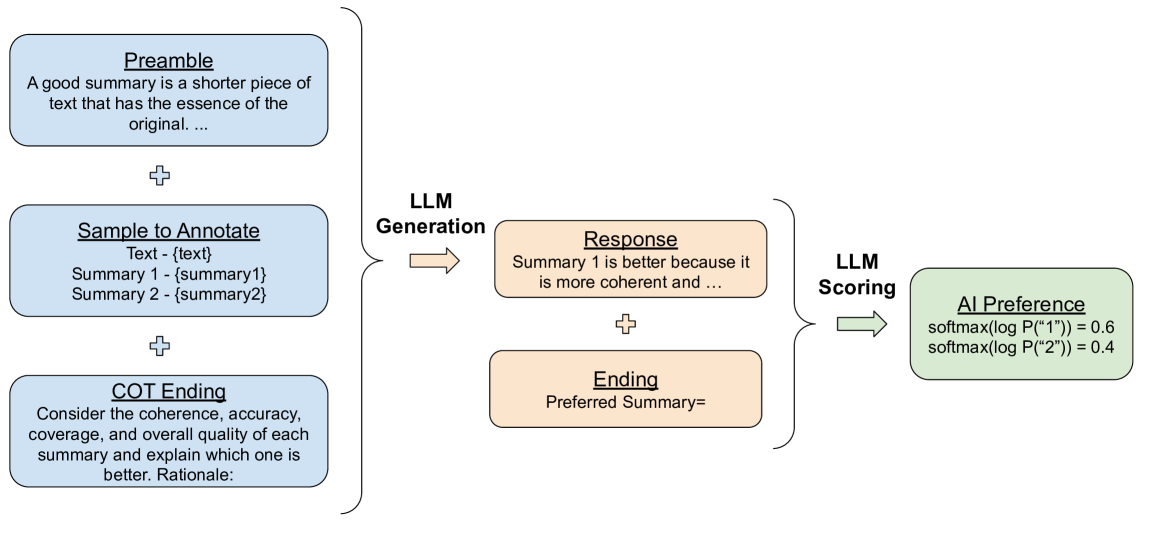
d-RLAIF 是本文的核心创新——完全绕过 reward model 训练,在 RL 阶段直接用 LLM 对生成结果打分。具体方法:让 LLM 对生成质量打 1-10 分,计算每个分数 token 的 likelihood 加权得到连续分数:
然后归一化到 区间作为 reward。
RL 优化
使用 REINFORCE 算法,目标函数包含 reward 最大化项和 KL 散度惩罚项:
其中 。
关键结果
主实验:RLAIF vs RLHF
| 任务 | RLAIF vs SFT | RLHF vs SFT | RLAIF vs RLHF |
|---|---|---|---|
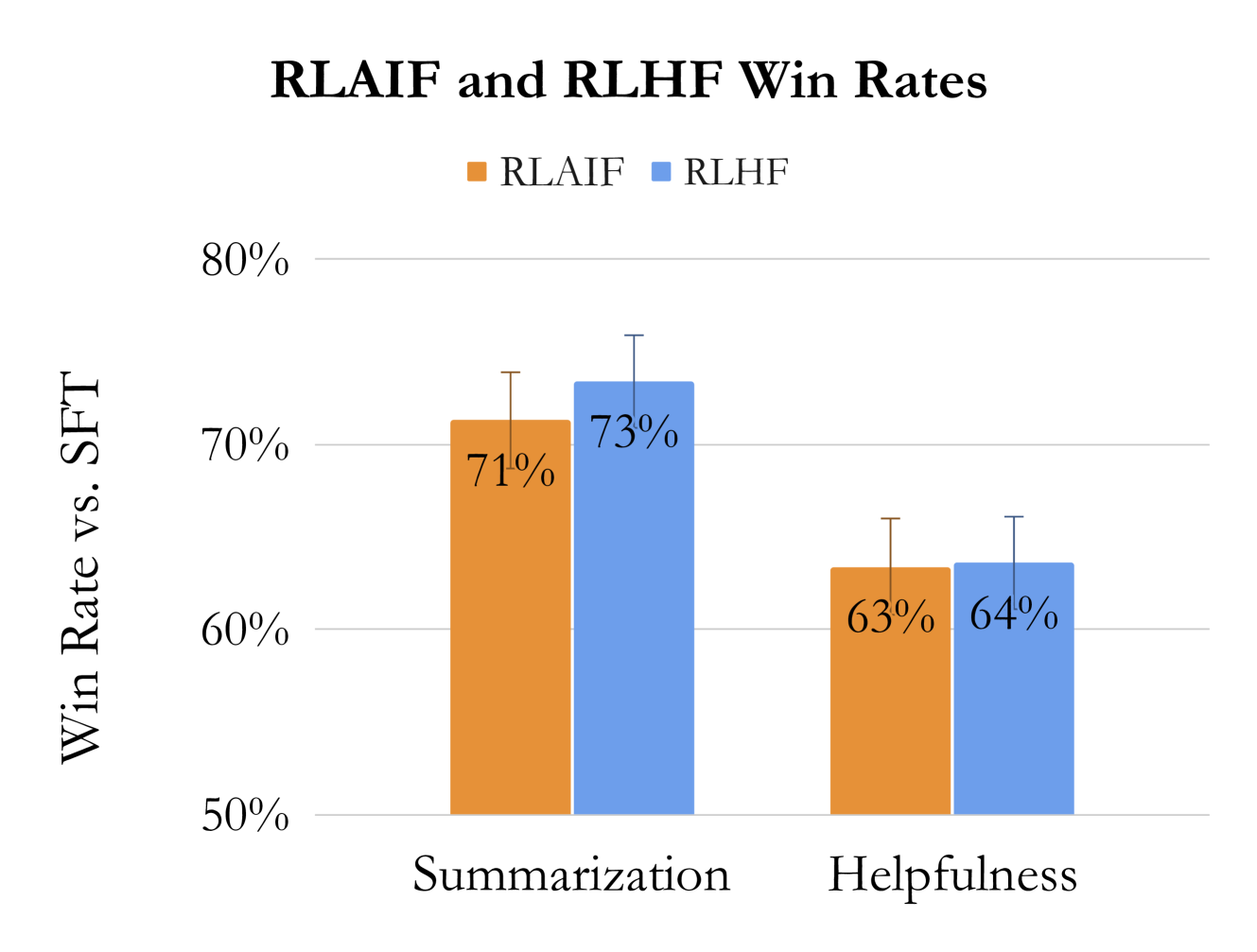
| Summarization | 71% | 73% | 50% |
| Helpful Dialogue | 63% | 64% | 52% |
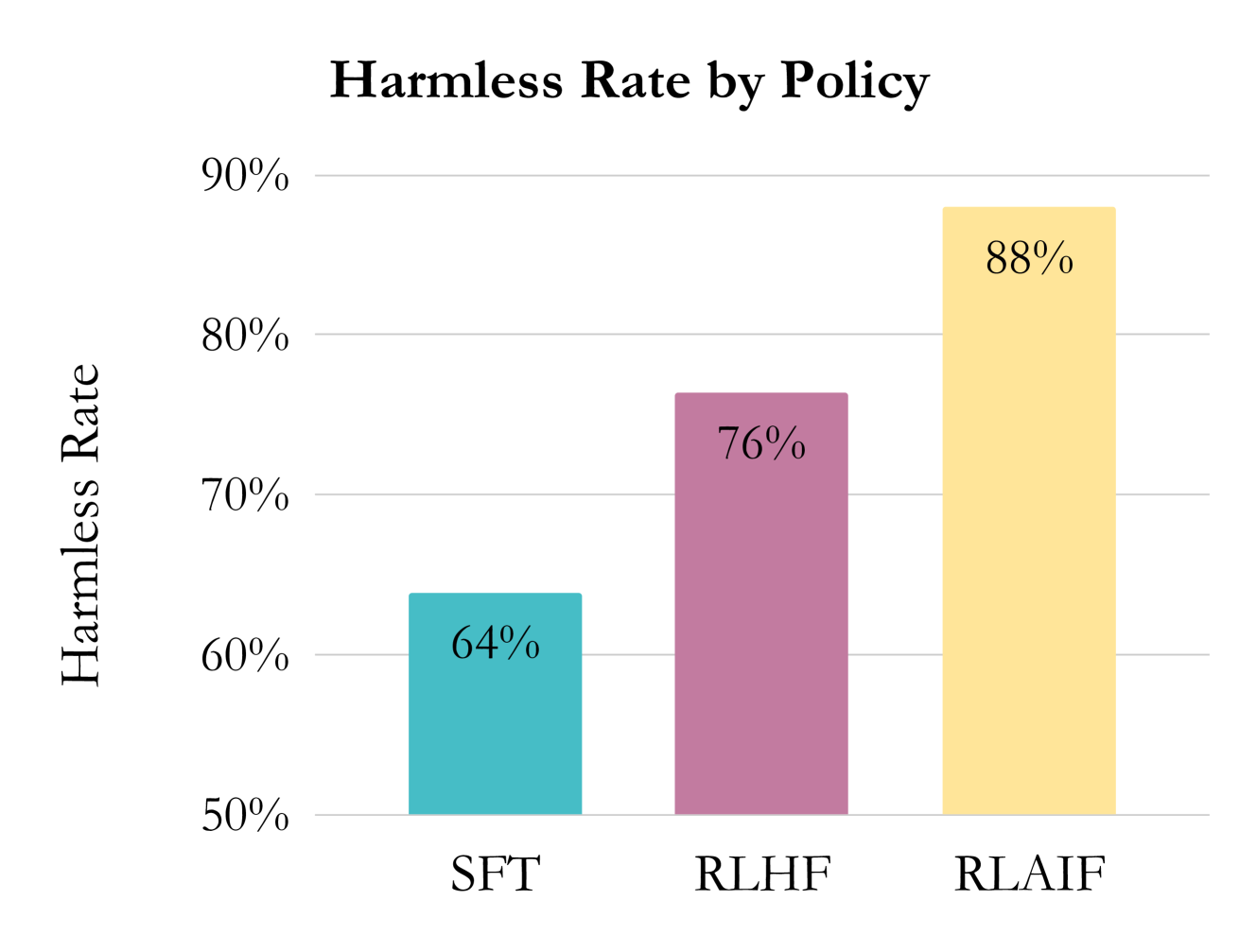
| Harmless Dialogue | 88% | 76% | - |
核心发现:RLAIF 在所有任务上与 RLHF 表现相当(head-to-head 约 50% win rate),在 harmless dialogue 上甚至显著优于 RLHF (p<0.05)。
Reward Model 准确率
| 任务 | Human RM | AI RM |
|---|---|---|
| Summarization | 79.3% | 74.2% |
| Helpful Dialogue | 76.0% | 67.8% |
| Harmless Dialogue | 72.1% | 69.7% |
AI RM 准确率略低于 Human RM,但最终 policy 质量差异不显著——说明 RM 准确率的差异不一定传导到最终对齐效果。
AI Labeler 对齐度 vs 模型大小
| 模型 | 与人类偏好对齐度 |
|---|---|
| PaLM 2 Large | 78.0% |
| PaLM 2 Small | 73.8% |
| PaLM 2 XS | 62.7% |
d-RLAIF 结果
| 任务 | d-RLAIF vs SFT | d-RLAIF vs Same-size RLAIF |
|---|---|---|
| Summarization | 74% | 60%(显著优于) |
| Helpful Dialogue | 66% | - |
d-RLAIF 在 summarization 上显著优于标准 RLAIF,且实现了真正的”自我改进”——labeler 和 policy 可以是同一个 checkpoint。
Ablation 分析
- CoT 推理:一致性提升 AI 标注质量,summarization 上从 76.1% 提升到 78.0%
- Few-shot:出乎意料地在 summarization/helpfulness 上降低对齐度(随示例数增加单调递减)
- 位置偏差:小模型偏差严重(PaLM 2 XS 56% 偏好同一位置),双向推理取平均有效消除
- 成本:LLM 标注成本估计为人类标注的 1/10 以下
总结性评价
本文最重要的贡献是提供了 RLAIF vs RLHF 的严格实验对比,结论令人振奋:AI 反馈可以达到人类反馈的对齐效果。d-RLAIF 进一步简化了流程,绕过 RM 训练直接用 LLM 打分,在部分任务上效果更优。这为大规模对齐提供了更 scalable 的路径。
值得注意的局限:(1) 实验基于 PaLM 2 系列模型,跨模型泛化性需验证;(2) 仅在 text 任务上评测,多模态场景待探索;(3) AI labeler 和 policy 同质化可能存在盲区(AI 偏好不等于真正的人类价值观)。
🔗 相关论文
基于/改进自: ConstitutionalAI
同方向: InstructGPT, Self-Rewarding