SimPO
📌 核心贡献
提出以序列平均对数概率作为无参考模型的隐式奖励,结合目标奖励间距项,实现比 DPO 更简单、更高效且性能更优的偏好优化算法。
📖 摘要
Direct Preference Optimization (DPO) is a widely used offline preference optimization algorithm that reparameterizes reward functions in reinforcement learning from human feedback (RLHF) to enhance simplicity and training stability. In this work, we propose SimPO, a simpler yet more effective approach. The effectiveness of SimPO is attributed to a key design: using the average log probability of a sequence as the implicit reward. This reward formulation better aligns with model generation and eliminates the need for a reference model, making it more compute and memory efficient. Additionally, we introduce a target reward margin to the Bradley-Terry objective to encourage a larger margin between the winning and losing responses, further improving the algorithm’s performance. We compare SimPO to DPO and its latest variants across various state-of-the-art training setups, including both base and instruction-tuned models such as Mistral, Llama 3, and Gemma 2. We evaluate on extensive chat-based evaluation benchmarks, including AlpacaEval 2, MT-Bench, and Arena-Hard. Our results demonstrate that SimPO consistently and significantly outperforms existing approaches without substantially increasing response length. Specifically, SimPO outperforms DPO by up to 6.4 points on AlpacaEval 2 and by up to 7.5 points on Arena-Hard. Our top-performing model, built on Gemma-2-9B-it, achieves a 72.4% length-controlled win rate on AlpacaEval 2, a 59.1% win rate on Arena-Hard, and ranks 1st on Chatbot Arena among <10B models with real user votes.
🔍 关键信息
| 字段 | 内容 |
|---|---|
| 机构 | University of Virginia, Princeton University |
| 发表 | 2024-05-23 |
| 分类 | cs.CL, cs.LG |
| 链接 | arXiv |
📝 我的笔记
方法总览

动机与问题定义
DPO 的隐式奖励使用策略模型与参考模型的对数概率比:
这存在两个关键问题:
- 计算开销:训练时需要同时维护参考模型,增加显存和计算成本
- 训练-推理不一致:DPO 的奖励排序 不一定意味着生成时的似然排序 。实验表明,仅约 50% 的训练样本同时满足奖励排序和似然排序
方法
SimPO 的核心思想是用序列平均对数概率直接作为隐式奖励,消除对参考模型的依赖。
1. 平均对数概率奖励
这一指标与 beam search 和多选任务中的排序指标完全一致,确保了训练目标与推理行为的对齐。
2. 长度归一化
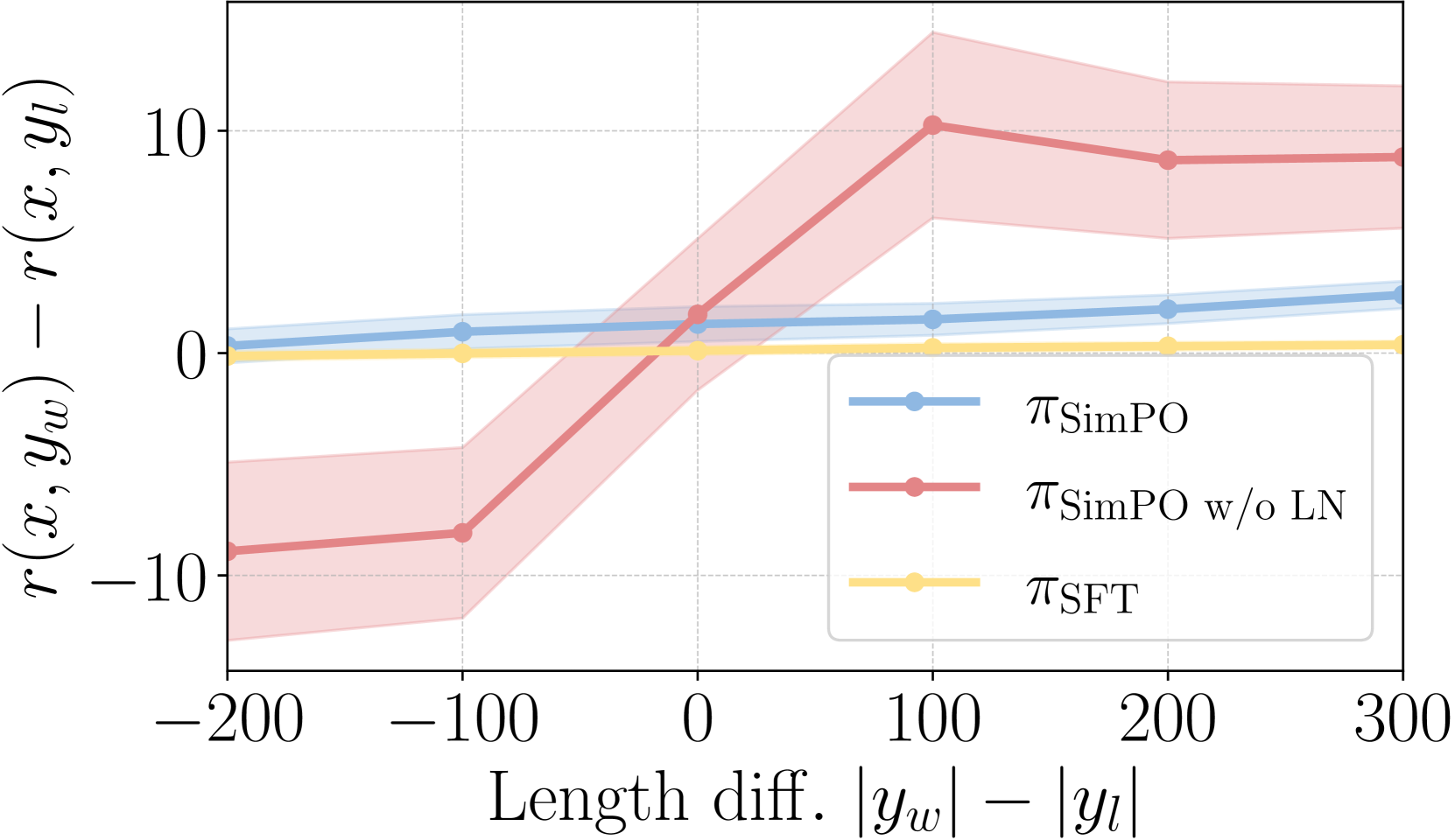
除以序列长度 消除了长度偏差。未归一化的对数概率总和天然偏向更长的序列。实验验证:
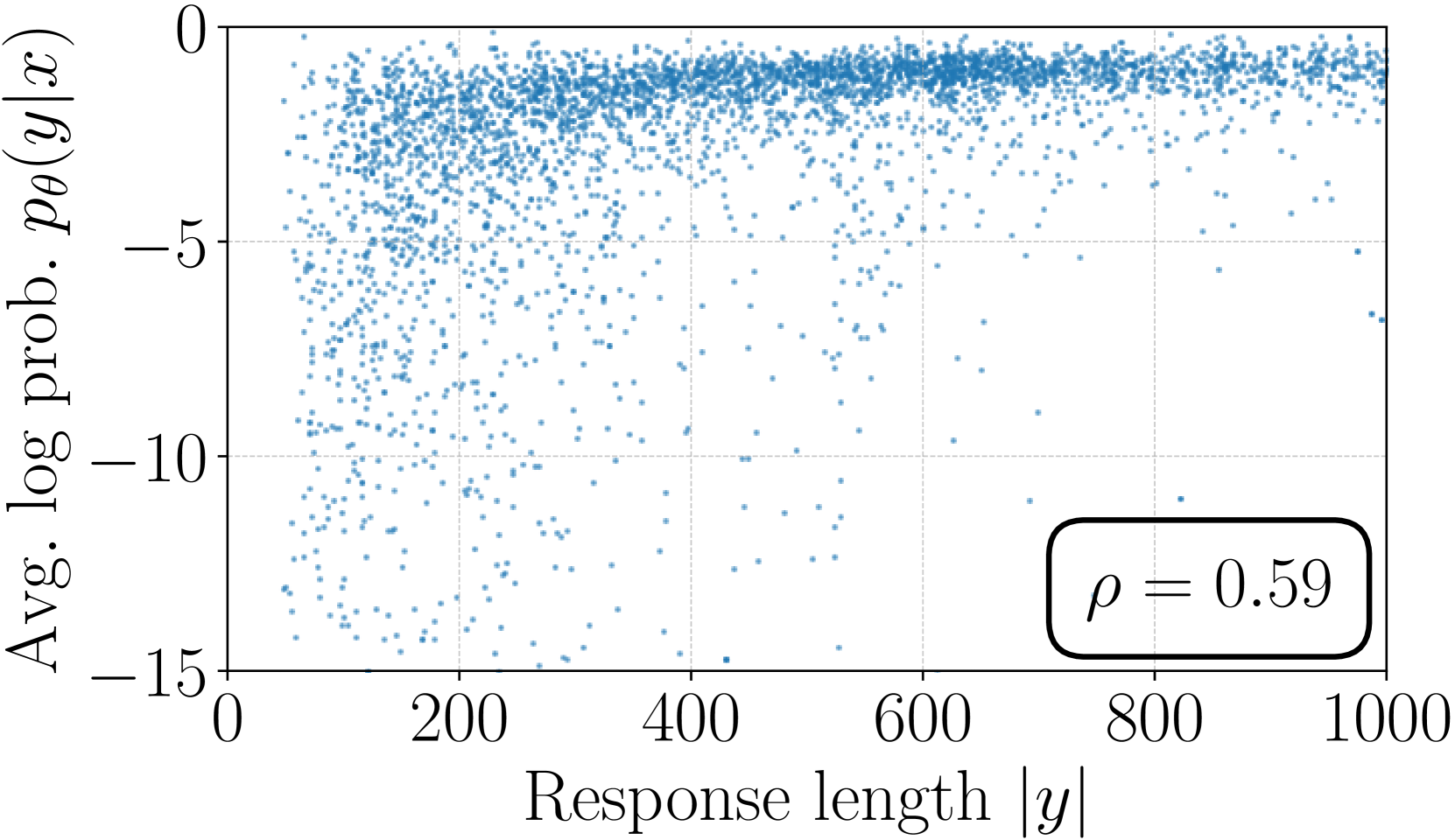
| 方法 | 平均对数似然与长度的 Spearman 相关系数 |
|---|---|
| SimPO w/o LN | ρ = 0.82(严重长度利用) |
| DPO | ρ = 0.59(隐式归一化) |
| SimPO | ρ = 0.34(最小相关性) |
3. 目标奖励间距 (γ)
在 Bradley-Terry 目标中引入间距项 γ,强制 winning 和 losing 响应之间保持最小奖励差距:
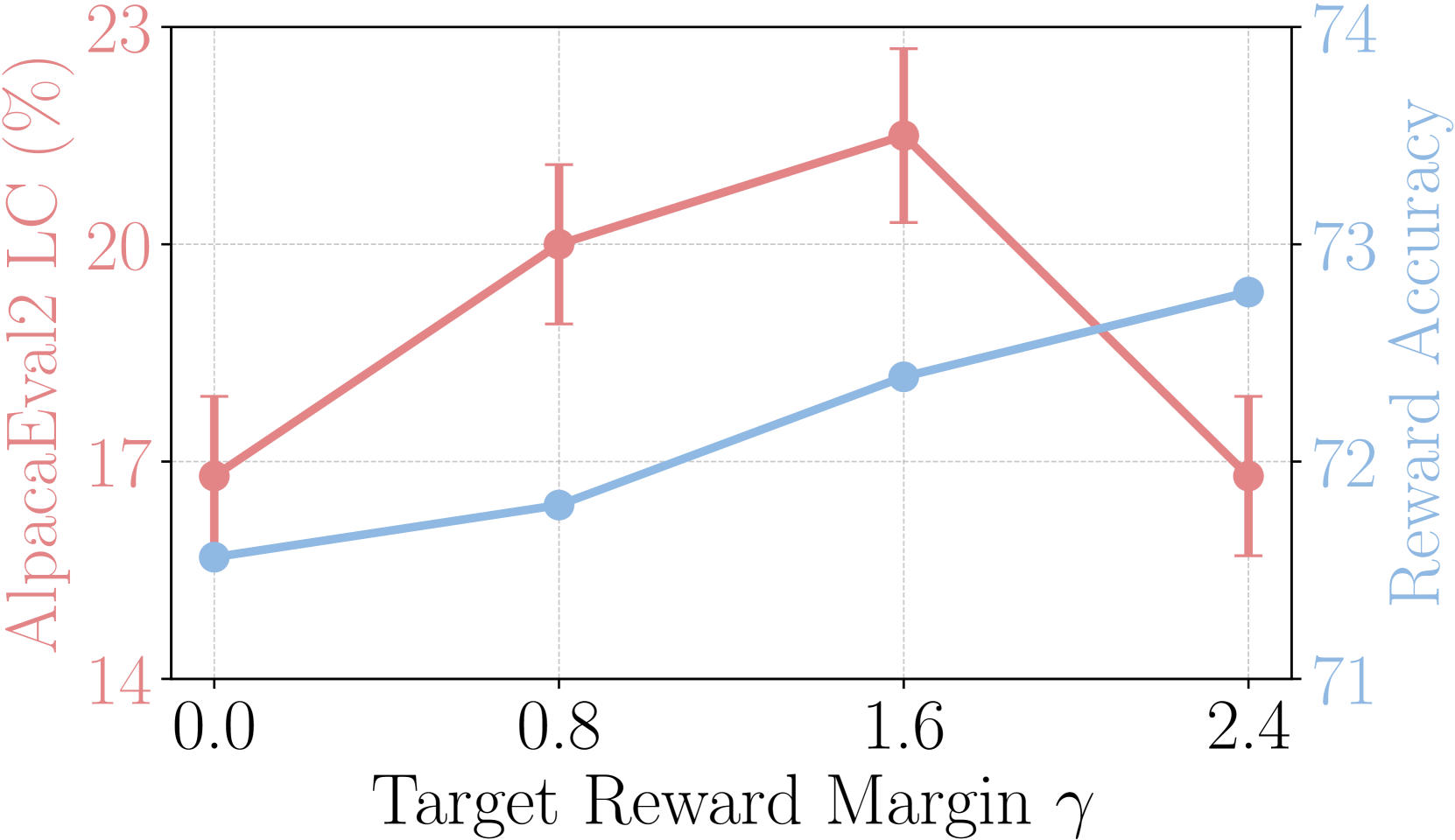
最优范围为 γ ∈ [0.5, 1.5]。
4. 完整 SimPO 目标函数
关键超参数:β ∈ [2.0, 2.5],γ ∈ [0.5, 1.5]。
DPO vs SimPO 对比
关键实验结果
主要结果
| 模型设置 | 方法 | AlpacaEval 2 LC | Arena-Hard WR | MT-Bench |
|---|---|---|---|---|
| Mistral-7B-Base | DPO | 15.1% | 10.4% | 5.9 |
| Mistral-7B-Base | SimPO | 21.5% | 16.6% | 6.0 |
| Llama-3-8B-Instruct | DPO | 40.3% | 37.9% | 7.0 |
| Llama-3-8B-Instruct | SimPO | 44.7% | 40.5% | 7.0 |
最佳模型 Gemma-2-9B-it-SimPO 达到:
- AlpacaEval 2 长度控制胜率 72.4%
- Arena-Hard 胜率 59.1%
- Chatbot Arena <10B 模型排名第 1
SimPO 相比 DPO 的最大提升:AlpacaEval 2 +6.4 分,Arena-Hard +7.5 分。
Ablation 分析
| 配置 | AlpacaEval 2 LC | Arena-Hard WR |
|---|---|---|
| DPO Baseline | 15.1% | 10.4% |
| SimPO(完整) | 21.5% | 16.6% |
| w/o 长度归一化 | 11.9% | 9.4% |
| γ = 0(无间距项) | 16.8% | 11.7% |
- 去除长度归一化:AlpacaEval 2 下降 9.6 分
- 去除间距项 γ:AlpacaEval 2 下降 4.7 分
- 两个组件均为关键设计
效率优势
SimPO 无需参考模型,相比 DPO:
- 训练时间减少约 20%
- GPU 显存减少约 10%
总结与评价
SimPO 是一个设计极为精巧的工作。核心洞察在于:DPO 的隐式奖励(策略/参考模型对数概率比)与实际推理时使用的排序指标(平均对数概率)存在根本性的不一致。SimPO 通过直接使用平均对数概率作为奖励,同时引入长度归一化和目标间距两个简单而有效的设计,在不增加任何计算开销的前提下实现了显著的性能提升。这一工作也揭示了 DPO 中训练目标与推理行为脱节的深层问题。
🔗 相关论文
基于/改进自: DPO
同方向: InstructGPT, RM-Survey