VideoScore
📌 核心贡献
构建首个大规模多维度视频生成人工标注数据集 VideoFeedback(37.6K 视频,覆盖 11 个生成模型),并在此基础上训练 VideoScore 评估模型,在视频偏好预测上 Spearman 相关性达 77.1,超越此前最佳指标约 50 个点。
📖 摘要
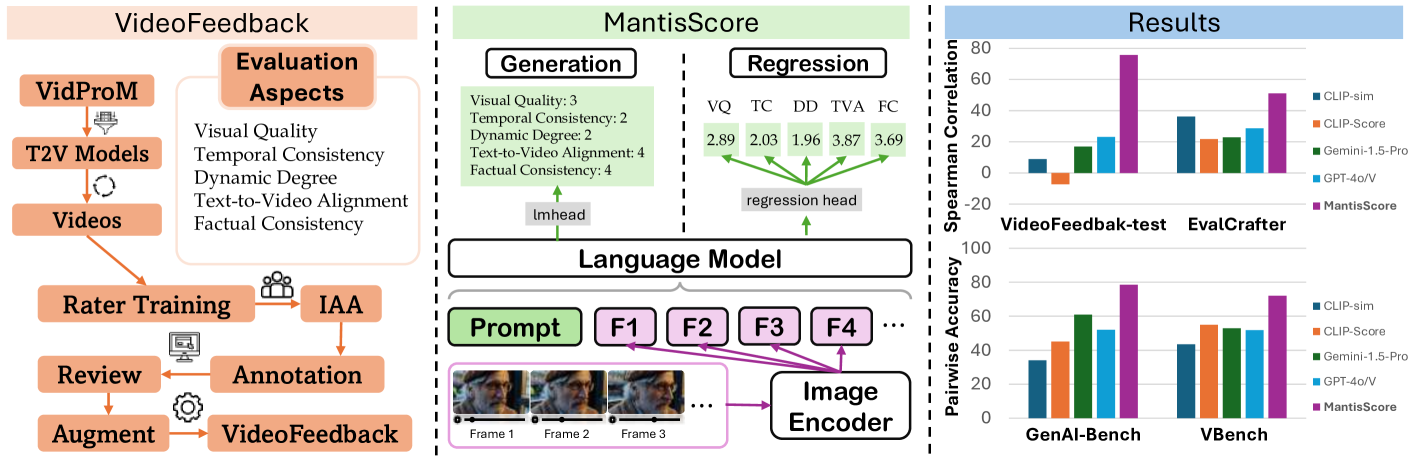
The development of text-to-video (T2V) generation models has been hindered by the lack of reliable automatic evaluation metrics. We introduce VideoFeedback, a large-scale dataset containing human-provided multi-aspect scores over 37.6K synthesized videos from 11 existing video generative models, with ratings across five fine-grained dimensions: Visual Quality, Temporal Consistency, Dynamic Degree, Text-to-Video Alignment, and Factual Consistency. We train VideoScore based on this dataset, achieving a Spearman correlation of 77.1 on VideoFeedback-test, beating the prior best metrics by about 50 points. VideoScore enables two key applications: tracking video generation model progress and simulating human feedback for RLHF video generation optimization.
🔍 关键信息
| 字段 | 内容 |
|---|---|
| 机构 | University of Waterloo |
| 发表 | 2024-06-21 |
| 分类 | cs.CV, cs.AI |
| 链接 | arXiv |
📝 我的笔记
方法总览
核心问题/动机
视频生成评估面临三大瓶颈:
- 分布级指标局限:FVD、IS 等无法评估单个视频输出
- 维度覆盖不全:多数指标仅关注视觉质量或文本对齐,忽略运动流畅性和事实一致性
- 人类相关性差:现有指标与人类偏好的相关性极低
方法
VideoFeedback 数据集构建
视频来源:
- 从 VidProM 筛选 31,600 个唯一 prompt(5-100 词,过滤 NSFW)
- 11 个 T2V 模型生成:Pika, Text2Video-Zero, VideoCrafter2, ModelScope, LaVie, AnimateDiff, LVDM, Hotshot-XL, ZeroScope, Fast-SVD, SORA-Clip
- 总计 33.6K 生成视频 + 4K 真实视频(DiDeMo, Panda70M)
标注流程:
- 20 名专家标注者,每人标注 1K-2K 视频
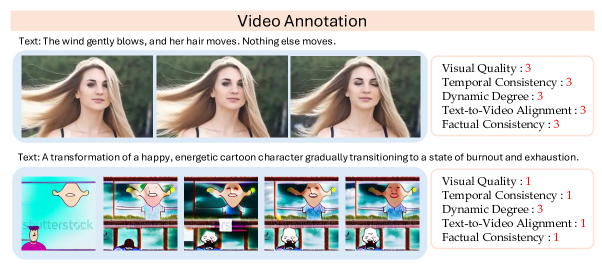
- 三分制(1=Bad, 2=Average, 3=Good),优质视频后标为 4=Perfect
五个评估维度:
| 维度 | 评估内容 |
|---|---|
| Visual Quality | 清晰度、分辨率、亮度、色彩 |
| Temporal Consistency | 跨帧的物体/人物一致性 |
| Dynamic Degree | 动态变化程度 |
| Text-to-Video Alignment | Prompt 与视频的语义对应 |
| Factual Consistency | 与常识和物理规律的一致性 |

VideoScore 模型
基座选择:Mantis-Idefics2-8B(支持 128 帧,原始分辨率输入)
两种评分方式:
- 生成式评分:模型输出固定格式文本(如 “visual quality: 3”),正则提取
- 回归式评分(最终采用):线性层替代语言头,输出 5 个 logits,MSE loss 训练
训练配置:学习率 1e-5,单 epoch,8×A100 (80G),约 6 小时
关键结果
VideoFeedback-test 性能(Spearman ρ)
| 维度 | VideoScore (gen) | VideoScore (reg) | GPT-4o(最佳基线) |
|---|---|---|---|
| Visual Quality | 86.2 | 84.7 | 35.2 |
| Temporal Consistency | 80.3 | 81.5 | 29.5 |
| Dynamic Degree | 77.6 | 68.4 | 38.0 |
| Text-to-Video Alignment | 59.4 | 59.5 | 26.6 |
| Factual Consistency | 82.1 | 84.6 | 32.4 |
| 平均 | 77.1 | 75.7 | 23.0 |
超越此前最佳方法(GPT-4o prompting)约 54 个点。
跨 benchmark 泛化
| Benchmark | VideoScore (reg) | 最佳基线 | 提升 |
|---|---|---|---|
| GenAI-Bench | 78.5% | 67.1% (Gemini) | +11.4 |
| EvalCrafter (TA) | 59.5 | 40.7 (GPT-4o) | +18.8 |
| VBench 平均 | 73.0% | 64.8% | +8.2 |
Best-of-K 采样
Best-of-5 选择可显著提升生成模型质量,例如 HotShot-XL 平均分从 46.83 提升至 69.52。
Ablation
| 基座模型 | 平均性能 |
|---|---|
| VideoLLaVA-7B | 42.7% |
| Idefics2-8B | 47.5% |
| Mantis-Idefics2-8B (gen) | 55.6% |
| Mantis-Idefics2-8B (reg) | 69.6% |
回归式评分全面优于生成式,Mantis 多图/视频基座的选择至关重要。
总结
VideoScore 通过在大规模人工标注数据上微调多模态模型,实现了视频质量自动评估的重大突破。回归式评分比生成式更稳定可靠。该工作的核心价值在于 VideoFeedback 数据集本身——覆盖 11 个模型、37.6K 视频、五维度标注的规模在当时是前所未有的。但 4 分制评分粒度较粗,且数据来自 pre-Sora 时代模型,对现代高质量视频的区分力有限(VideoAlign 的 benchmark 中 VideoScore 仅 41.8%)。
🔗 相关论文
同方向: VisionReward, VideoAlign, LiFT