VL-RewardBench
📌 核心贡献
提出首个系统性评估视觉语言生成式奖励模型(VL-GenRM)的挑战性基准,包含 1,250 个精心筛选的偏好对,覆盖通用多模态、幻觉检测和复杂推理三大类任务,揭示了当前模型在基础视觉感知而非推理上的核心瓶颈。
📖 摘要
Vision-language generative reward models (VL-GenRMs) play a critical role in aligning multimodal AI systems. They serve dual functions in this context: they provide training signals to guide the learning of vision-language models and act as evaluators to assess the quality of generated outputs. Despite their importance, current assessment methods for VL-GenRMs rely on general-purpose benchmarks that do not adequately capture their reward-specific capabilities. To address this gap, we introduce VL-RewardBench, a comprehensive benchmark specifically designed to evaluate the reward judgment capabilities of these models. VL-RewardBench spans three key domains: general multimodal queries, visual hallucination detection, and complex reasoning tasks, comprising 1,250 curated examples. Through extensive evaluation of 16 leading models, including both open-source and proprietary systems, we uncover several critical findings: (1) even the best-performing model, GPT-4o, achieves only 65.4% accuracy, revealing substantial room for improvement; (2) open-source models consistently underperform compared to proprietary systems across all categories; (3) models primarily struggle with basic visual perception rather than complex reasoning; (4) inference-time scaling benefits vary significantly based on model capacity; and (5) training dedicated critic models substantially improves judgment accuracy by up to 14.7% for smaller models. Our benchmark provides a valuable resource for advancing the development and evaluation of VL-GenRMs.
🔍 关键信息
| 字段 | 内容 |
|---|---|
| 机构 | HKU, SCUT, SJTU, PKU, UW, Allen AI |
| 发表 | 2024-11-26 |
| 分类 | cs.CV, cs.CL |
| 链接 | arXiv |
📝 我的笔记
方法总览
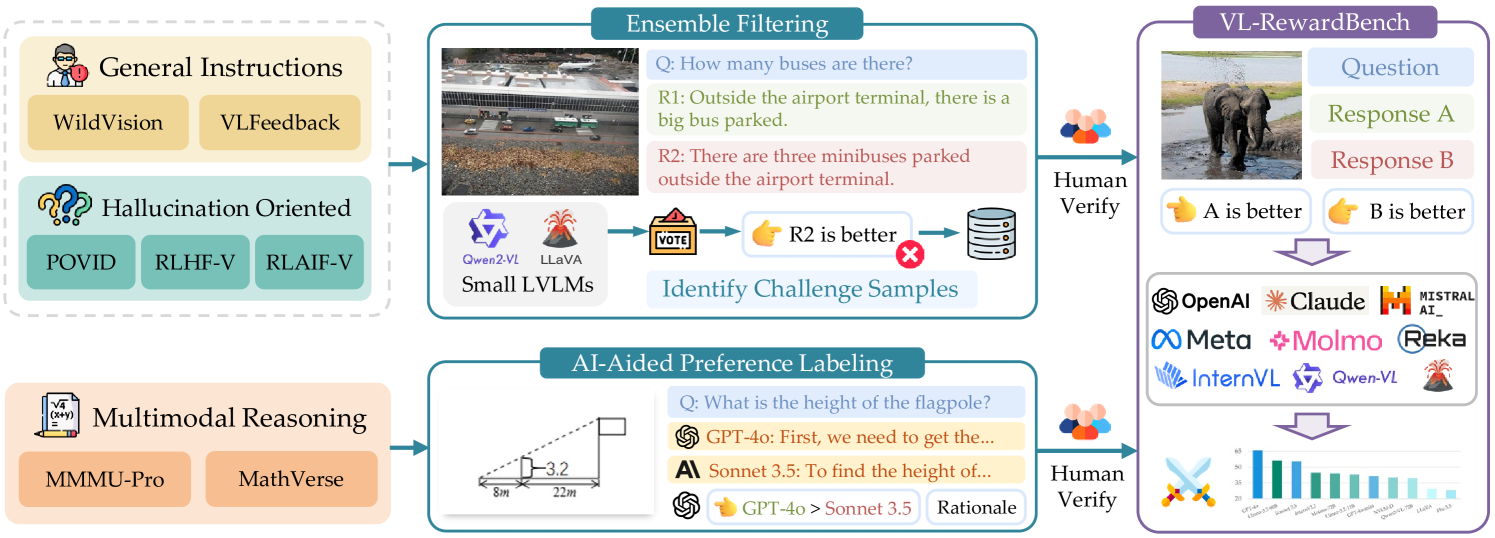
动机与问题定义
视觉语言生成式奖励模型(VL-GenRM)在多模态 AI 对齐中承担两项关键功能:(1) 提供训练信号指导 VLM 学习,(2) 作为评估器评判生成输出质量。然而,当前评估方法依赖通用基准,无法充分捕捉奖励模型特有的判断能力。VL-RewardBench 旨在填补这一空白,提供一个专门评估 VL-GenRM 偏好判断能力的挑战性基准。
基准构建
VL-RewardBench 包含 1,250 个偏好对,覆盖三大领域:
| 领域 | 数量 | 占比 | 数据来源 |
|---|---|---|---|
| 通用多模态指令 | 183 | 14.7% | VLFeedback, WildVision |
| 幻觉导向查询 | 749 | 59.9% | POVID, RLAIF-V, RLHF-V |
| 多模态推理 | 318 | 25.4% | MMMU-Pro, MathVerse |
策略一:集成过滤(通用 + 幻觉任务)
- 使用 4 个 7B 小模型(LLaVA-1.5, LLaVA-1.6, LLaVA-OneVision-7B-si, Qwen2-VL-7B)评估偏好对
- 每对进行 3 次评估,随机化响应位置
- 筛选所有模型均一致判断错误的”共同集”(3,785 候选)
- 三阶段人工验证缩减至 932 个高质量偏好对:标签准确性检查 → 质量/歧义过滤 → 错误类型分类(每样本约 65 秒)
策略二:AI 辅助标注(推理任务)
- 商业模型(GPT-4o, GPT-4o-mini, Claude 3.5 Sonnet)生成响应
- 长度控制配对,阈值 :
- GPT-4o 生成带理由的草稿标签
- 三位作者验证,最终得到 318 个推理任务偏好对
错误类型分布
| 错误类型 | 数量 | 占比 |
|---|---|---|
| 存在性错误 | 531 | 59.3% |
| 识别错误 | 184 | 20.6% |
| 视觉属性错误 | 69 | 7.7% |
| 计数错误 | 60 | 6.7% |
| 其他错误 | 51 | 5.7% |
评估协议
- 每个偏好对进行 次独立评估
- 随机化响应顺序以缓解位置偏差
- 多数投票确定最终偏好
- 固定解码参数:temperature=0.2, top_p=0.2
- 主要指标:Overall Accuracy 和 Macro Average Accuracy(跨类别均值,应对类别不平衡)
关键结果
主要性能(Table 2)
商业模型:
| 模型 | General | Hallucination | Reasoning | Overall | Macro Avg |
|---|---|---|---|---|---|
| GPT-4o | 49.1% | 67.6% | 70.5% | 65.8% | 62.4% |
| Gemini-1.5-Pro | 50.8% | 72.5% | 64.2% | 67.2% | 62.5% |
| Claude-3.5-Sonnet | 43.4% | 55.0% | 62.3% | 55.3% | 53.6% |
开源模型:
| 模型 | General | Hallucination | Reasoning | Overall | Macro Avg |
|---|---|---|---|---|---|
| Llama-3.2-90B | 42.6% | 57.3% | 61.7% | 56.2% | 53.9% |
| Qwen2-VL-72B | 38.1% | 32.8% | 58.0% | 39.5% | 43.0% |
| Qwen2-VL-7B | - | - | - | 28.3% | - |
错误率分析
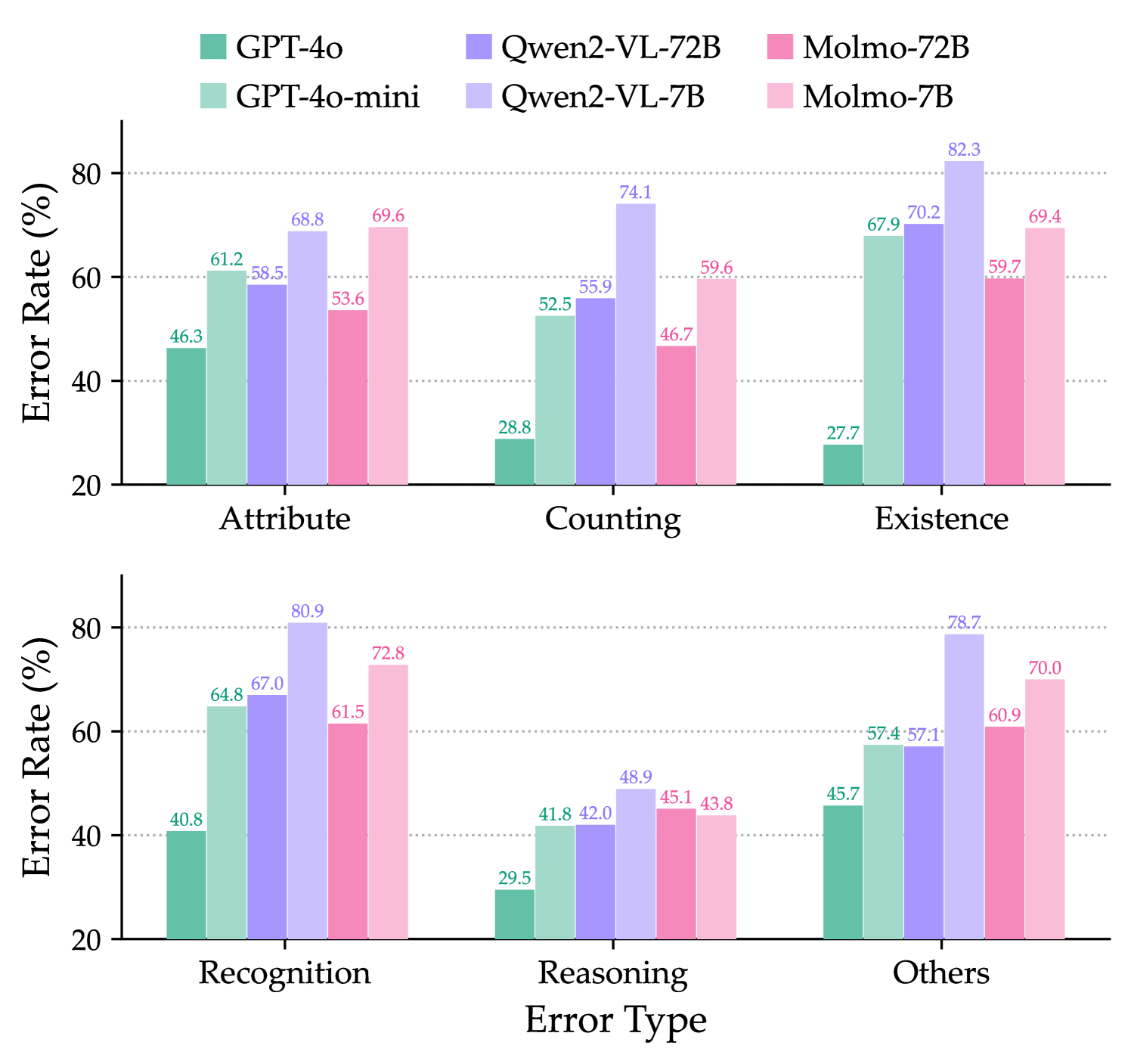
- 感知瓶颈:存在性任务中 GPT-4o-mini 错误率 67.9%,Qwen2-VL-7B 在识别任务上错误率 80.9%
- 推理任务:平均错误率 41.8%,显著低于感知任务
- 模型缩放:Qwen2-VL 从 7B 到 72B,计数错误降低 18.2 个百分点
推理时缩放
- GPT-4o:macro accuracy 从 60.3% (K=1) 提升至 62.7% (K=7)
- GPT-4o-mini:不同 K 值下变化极小
- Qwen2-VL-72B 和 Molmo-72B:K 增大反而下降 1.7-2.6 个百分点
- 结论:推理时缩放仅对大容量模型有效
Critic 训练效果
| 模型 | 基准 | Pointwise Critic | Pairwise Critic |
|---|---|---|---|
| LLaVA-OneVision | 38.2% | 52.9% (+14.7%) | 47.4% (+9.2%) |
- Pointwise critic 在幻觉检测上优于 pairwise(+9.1%)
- Pairwise critic 在推理任务上表现更好(60.0%)
下游任务相关性
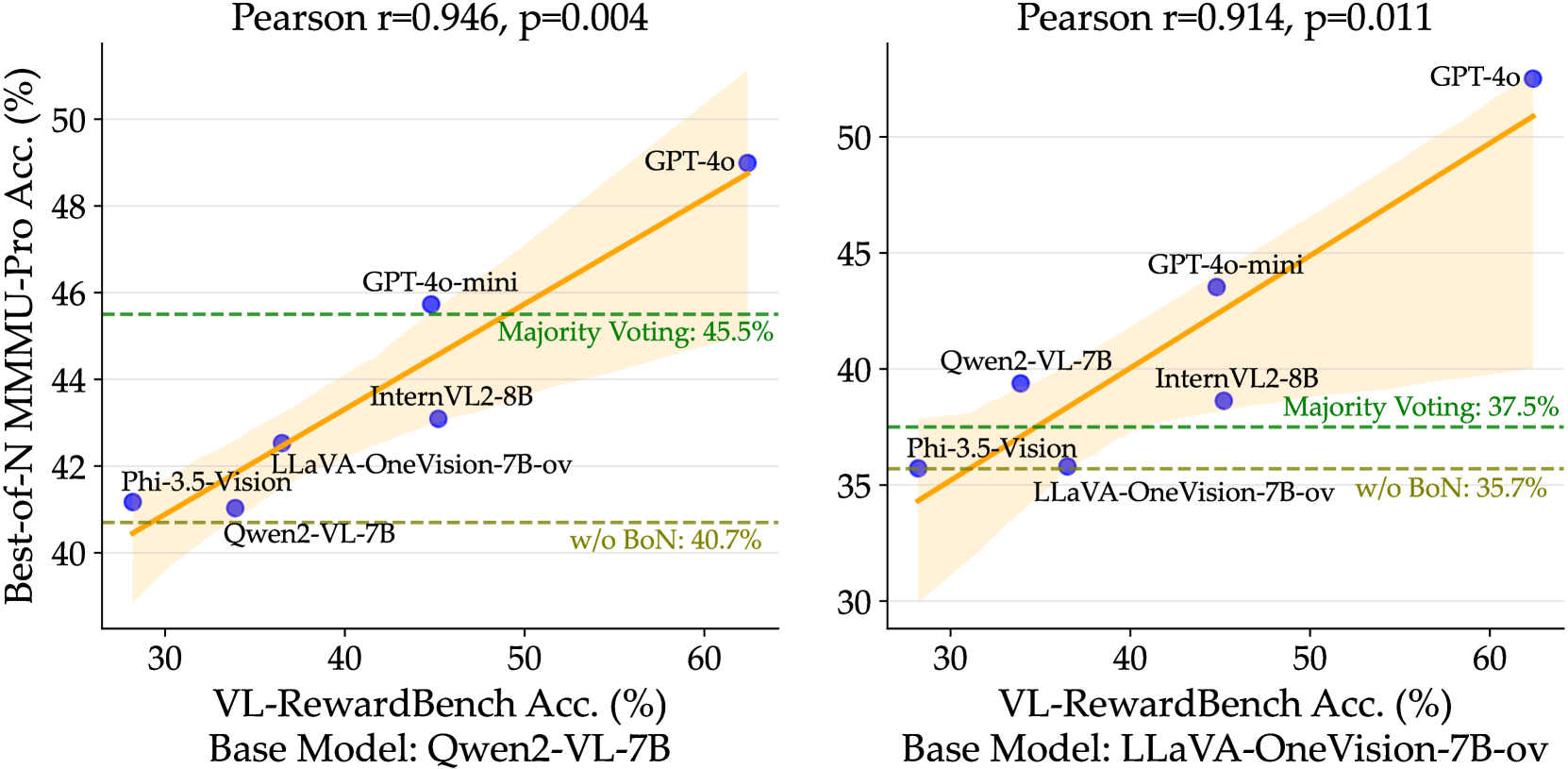
VL-RewardBench 准确率与 Best-of-N 采样下游改进高度相关:
- Qwen2-VL-7B:Pearson
- LLaVA-OneVision-7B-ov:
- GPT-4o 作为选择器可将 LLaVA-OneVision 在 MMMU-Pro 上从 35.7% 提升至 52.5%(N=8)
总结性评价
VL-RewardBench 作为首个专门评估 VL 奖励模型的基准,有几个突出贡献:(1) 通过集成过滤策略确保样本的挑战性,避免了简单样本占主导的问题;(2) 揭示了模型在视觉感知而非推理上的核心瓶颈,为改进方向提供了明确指引;(3) 与下游 Best-of-N 任务的高相关性(r > 0.9)验证了基准的实用价值。不足之处在于幻觉类样本占比偏高(59.9%),通用和推理类样本相对较少,可能影响评估的全面性。
🔗 相关论文
基于/改进自: LLaVA-Critic
同方向: RewardBench2, MMRB2, UnifiedReward