VideoAlign
📌 核心贡献
构建完整的视频生成人类反馈对齐流水线:182K 现代 T2V 模型偏好标注数据集 + 基于 Bradley-Terry-with-Ties 的多维度视频奖励模型 VideoReward + 三种 Flow-based 对齐算法(Flow-DPO/Flow-RWR/Flow-NRG),发现 Flow-DPO 使用常数 β 显著优于理论推导的时序依赖 β_t 调度。
📖 摘要
Video generation has achieved significant advances through rectified flow techniques, but issues like unsmooth motion and misalignment between videos and prompts persist. We develop a systematic pipeline incorporating human feedback: (1) a large-scale preference dataset with 182K annotated triplets from 12 representative text-to-video models, rated across visual quality, motion quality, and text alignment; (2) VideoReward, a multi-dimensional reward model based on Qwen2-VL-2B with Bradley-Terry-with-Ties formulation and context-aware token positioning; (3) three complementary alignment algorithms—Flow-DPO and Flow-RWR for training-time optimization, and Flow-NRG for inference-time guidance. Flow-DPO with constant KL regularization demonstrates superior performance compared to both Flow-RWR and supervised fine-tuning methods.
🔍 关键信息
| 字段 | 内容 |
|---|---|
| 机构 | Kuaishou Technology |
| 发表 | 2025-01-23 |
| 分类 | cs.CV, cs.AI, cs.GR, cs.LG |
| 链接 | arXiv |
📝 我的笔记
方法总览
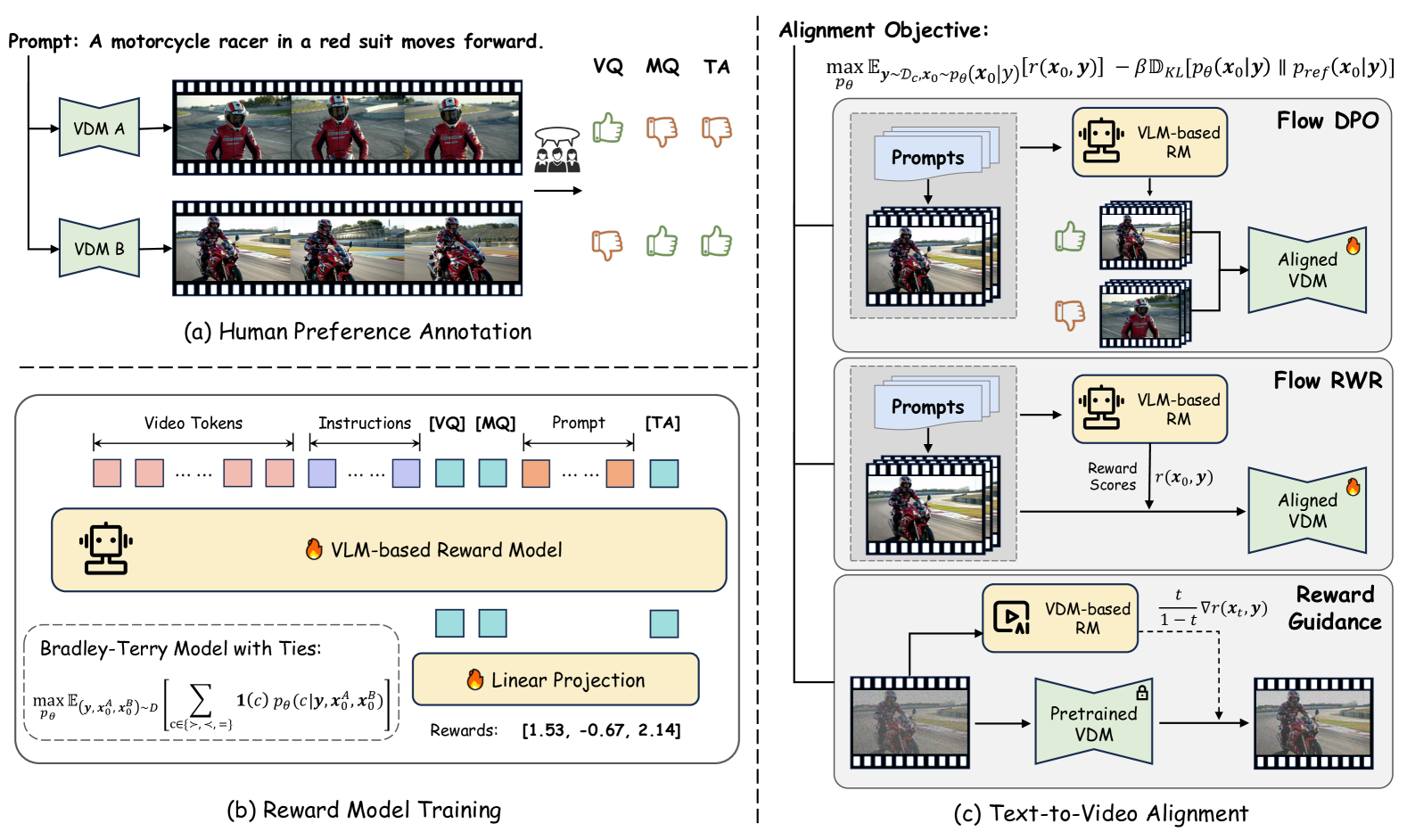
核心问题/动机
- 数据过时:现有偏好数据集收集自 pre-Sora 时代的低分辨率短视频模型,与现代高保真视频生成能力严重不匹配
- 奖励模型泛化差:VideoScore 等在旧数据上训练的 RM 对现代模型的区分力极低(benchmark 上仅 41.8%)
- Flow 模型对齐空白:将 RLHF 从扩散模型适配到 Rectified Flow 模型引入新的技术问题
方法
A. 偏好数据集构建
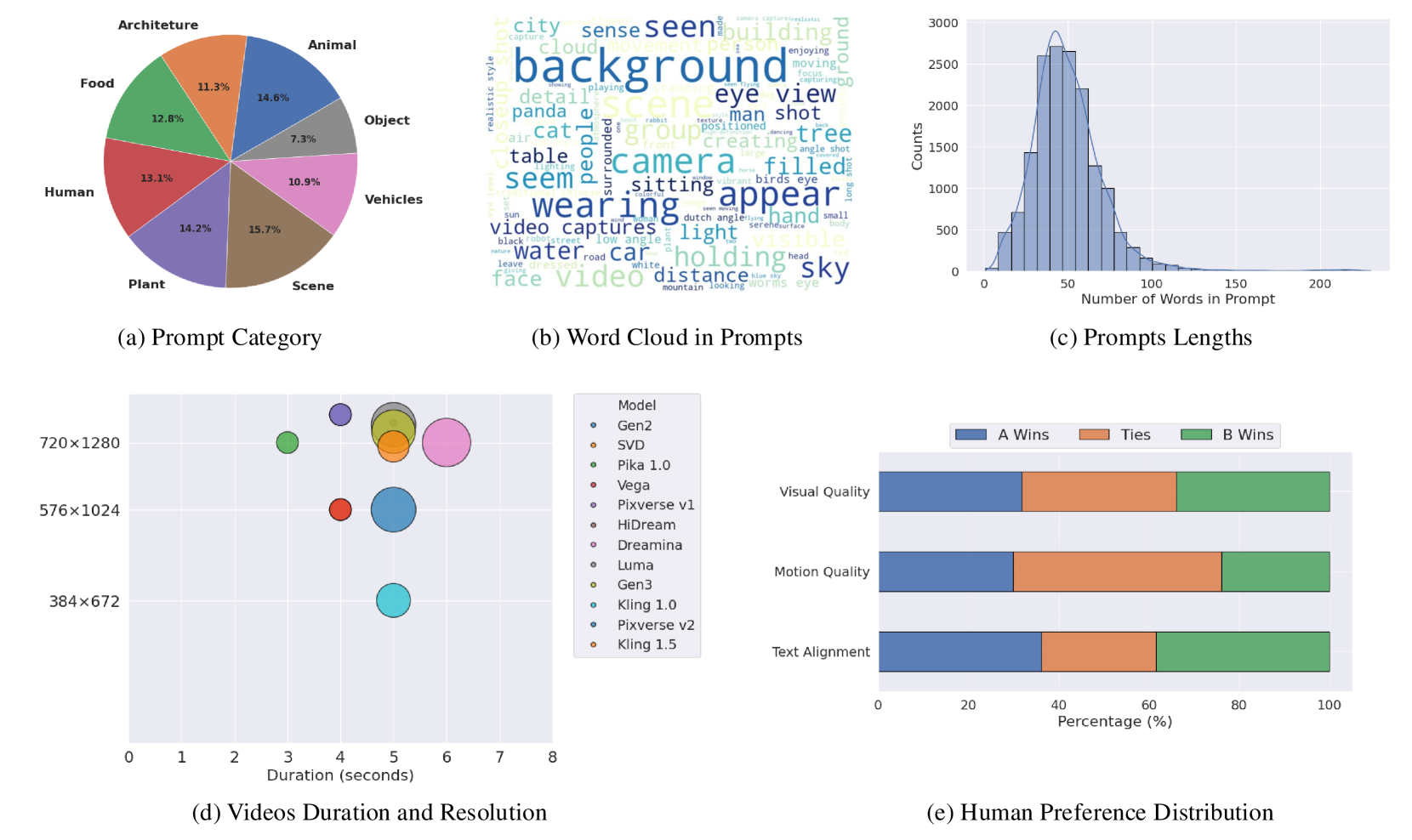
- 规模:182K 标注三元组,来自 12 个 T2V 模型生成的 108K 视频,基于 16K 精选 prompt
- 三维度标注:
- Visual Quality (VQ):空间保真度和伪影评估
- Motion Quality (MQ):时序连贯性和运动流畅度
- Text Alignment (TA):与输入 prompt 的语义一致性
- 每个三元组标注 pairwise 偏好(A 胜 / 平局 / B 胜)+ 个体 1-5 Likert 打分
B. VideoReward 奖励模型
基座:Qwen2-VL-2B(轻量级 VLM)
三个设计创新:
1. Bradley-Terry with Ties (BTT)
标准 BT 模型仅建模二元胜负,BTT 引入平局概率:
参数 控制平局倾向。BTT 将平局样本聚集在 附近,同时保持明确胜负样本的大间距。
2. Context-Aware Token Positioning
[VQ],[MQ]token 放置在视频之后、prompt 之前——仅关注视觉内容[TA]token 放置在完整 prompt 之后——允许全模态上下文
消除 “context leakage”:同一视频搭配不同 prompt 时不会得到不同的视觉质量分。
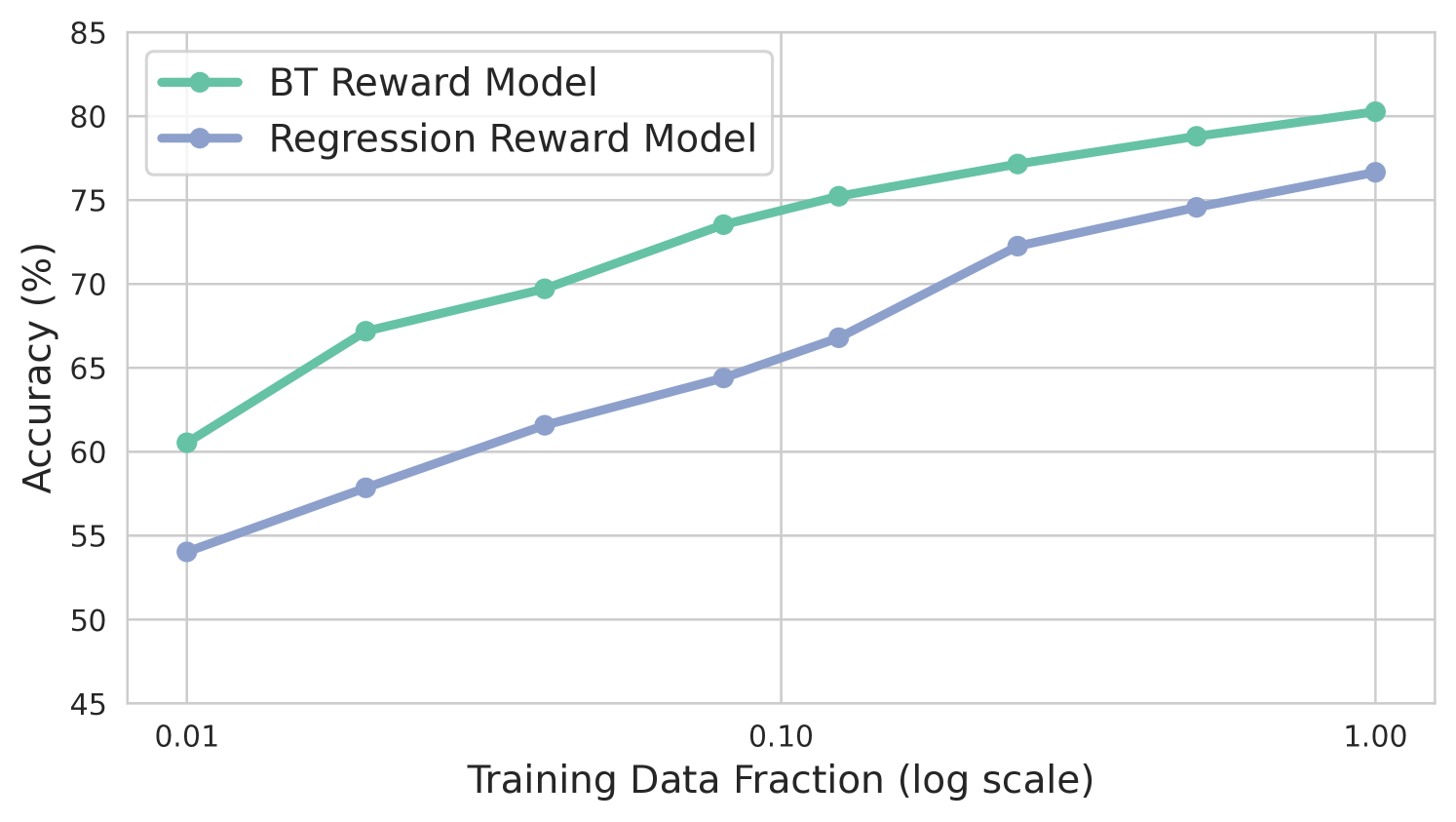
3. BT 优于回归
Bradley-Terry 范式在所有数据量下一致优于 pointwise MSE 回归,因为 pairwise 标注更有效捕获细微相对差异。
C. 三种对齐算法
统一 RL 目标:
Flow-DPO(训练时,主推):
关键发现:理论推导的时序依赖 导致模型在高噪声层过度优化,引发 reward hacking。使用常数 β 显著优于 β_t 调度,与 DDPM 中去除 loss 加权可提升样本质量的发现一致。
Flow-RWR(训练时):奖励加权回归,按 加权 velocity loss。
Flow-NRG(推理时,无需训练):
类似 classifier guidance,在推理时将轨迹引向高奖励区域,支持用户自定义维度权重。
关键结果
奖励模型评估(VideoGen-RewardBench)
| 方法 | Overall Acc (w/ Ties) | VQ Acc | MQ Acc | TA Acc |
|---|---|---|---|---|
| Random | 41.86% | 47.42% | 59.07% | 37.25% |
| VideoScore | 41.80% | 47.41% | 59.05% | 37.24% |
| LiFT | 39.08% | 47.53% | 59.04% | 33.79% |
| VisionReward | 56.77% | 47.43% | 59.03% | 46.56% |
| VideoReward | 61.26% | 59.68% | 66.03% | 53.80% |
多维度对齐结果(VQ:MQ:TA = 1:1:1)
| 方法 | VQ Win Rate | MQ Win Rate | TA Win Rate | VBench Quality |
|---|---|---|---|---|
| Pretrained | 50.0% | 50.0% | 50.0% | 83.19 |
| SFT | 51.28% | 65.21% | 52.84% | 82.31 |
| Flow-RWR | 51.55% | 63.9% | 53.43% | 82.27 |
| Flow-DPO (β_t) | 87.78% | 82.36% | 51.02% | 80.90 |
| Flow-DPO (const β) | 93.42% | 69.08% | 75.43% | 83.41 |
文本对齐专项(TA Focus)
| 方法 | TA Win (VideoGen-Eval) | TA Win (TA-Hard) |
|---|---|---|
| Pretrained | 50.00% | 50.00% |
| Flow-DPO (β_t) | 63.67% | 71.83% |
| Flow-DPO (const β) | 69.09% | 84.51% |
Ablation
- BT vs 回归:BT 在所有数据量下一致优于回归,且差距随数据量增大
- BTT 处理平局:标准 BT 对平局样本赋予过大 Δr,BTT 有效聚集在零附近
- Context-aware token:消除 context leakage,稳定视觉/运动评估
- 常数 β vs β_t:常数 β 全面优于时序调度,避免 reward hacking(β_t 下 TA-Hard 从 50% 降到 28%)
总结
这是一个非常完整的视频生成对齐 pipeline。核心技术贡献有三:(1) BTT 对平局的优雅处理,(2) context-aware token positioning 消除 context leakage,(3) 常数 β 优于理论 β_t 的实证发现。Flow-NRG 的推理时引导特别实用——用户可在推理时自定义 VQ/MQ/TA 权重比例,无需重新训练。
🔗 相关论文
基于/改进自: VideoScore
同方向: VisionReward, LiFT, RewardDance