Skywork-VL Reward
📌 核心贡献
将 Skywork-Reward 扩展到多模态领域,通过构建大规模多模态偏好数据集(~190K)和两阶段微调策略,在 VL-RewardBench 上以 7B 参数量取得 SOTA(73.1%),超越 Gemini-2.0-flash-exp 等闭源模型,同时在纯文本 RewardBench 上保持 90.1 的竞争力。
📖 摘要
We propose Skywork-VL Reward, a multimodal reward model that provides reward signals for both multimodal understanding and reasoning tasks. Our technical approach comprises two key components: First, we construct a large-scale multimodal preference dataset that covers a wide range of tasks and scenarios, with responses collected from both standard vision-language models (VLMs) and advanced VLM reasoners. Second, we design a reward model architecture based on Qwen2.5-VL-7B-Instruct, integrating a reward head and applying multi-stage fine-tuning using pairwise ranking loss on pairwise preference data. Experimental evaluations show that Skywork-VL Reward achieves state-of-the-art results on multimodal VL-RewardBench and exhibits competitive performance on the text-only RewardBench benchmark. Furthermore, preference data constructed based on our Skywork-VL Reward proves highly effective for training Mixed Preference Optimization (MPO), leading to significant improvements in multimodal reasoning capabilities. Our results underscore Skywork-VL Reward as a significant advancement toward general-purpose, reliable reward models for multimodal alignment. Our model has been publicly released to promote transparency and reproducibility.
🔍 关键信息
| 字段 | 内容 |
|---|---|
| 机构 | Skywork AI, Kunlun Inc. |
| 发表 | 2025-05-12 |
| 分类 | cs.CV |
| 链接 | arXiv |
📝 我的笔记
方法总览

核心问题/动机
现有奖励模型主要针对纯文本场景(如 Skywork-Reward),缺乏对多模态视觉-语言任务的支持。本文将 Skywork-Reward 的数据中心方法论扩展到多模态领域,核心挑战在于:(1) 高质量多模态偏好数据稀缺;(2) 推理类多模态任务(数学、科学图表等)需要专门的数据构建策略。
数据构建
开源数据(~190K 总量的主体)
| 数据集 | 数量 | 特点 |
|---|---|---|
| LLaVA-Critic-113k | 113K | GPT-4o 生成的多模态点对评分和成对排序 |
| Skywork-Reward-Preference-80K-v0.2 | 80K | 纯文本偏好对(Q&A + 创意写作) |
| RLAIF-V-Dataset | 83K | 多模态偏好对 |
三阶段数据处理流水线
Stage 1(过滤):跨源去重 + 语义相似度过滤 + 模糊判断过滤 → ~200K 高置信偏好对
Stage 2(质量增强):低分 chosen 响应用 GPT-4o 重新生成;分数差异过小的对被增强 → 保留 150K
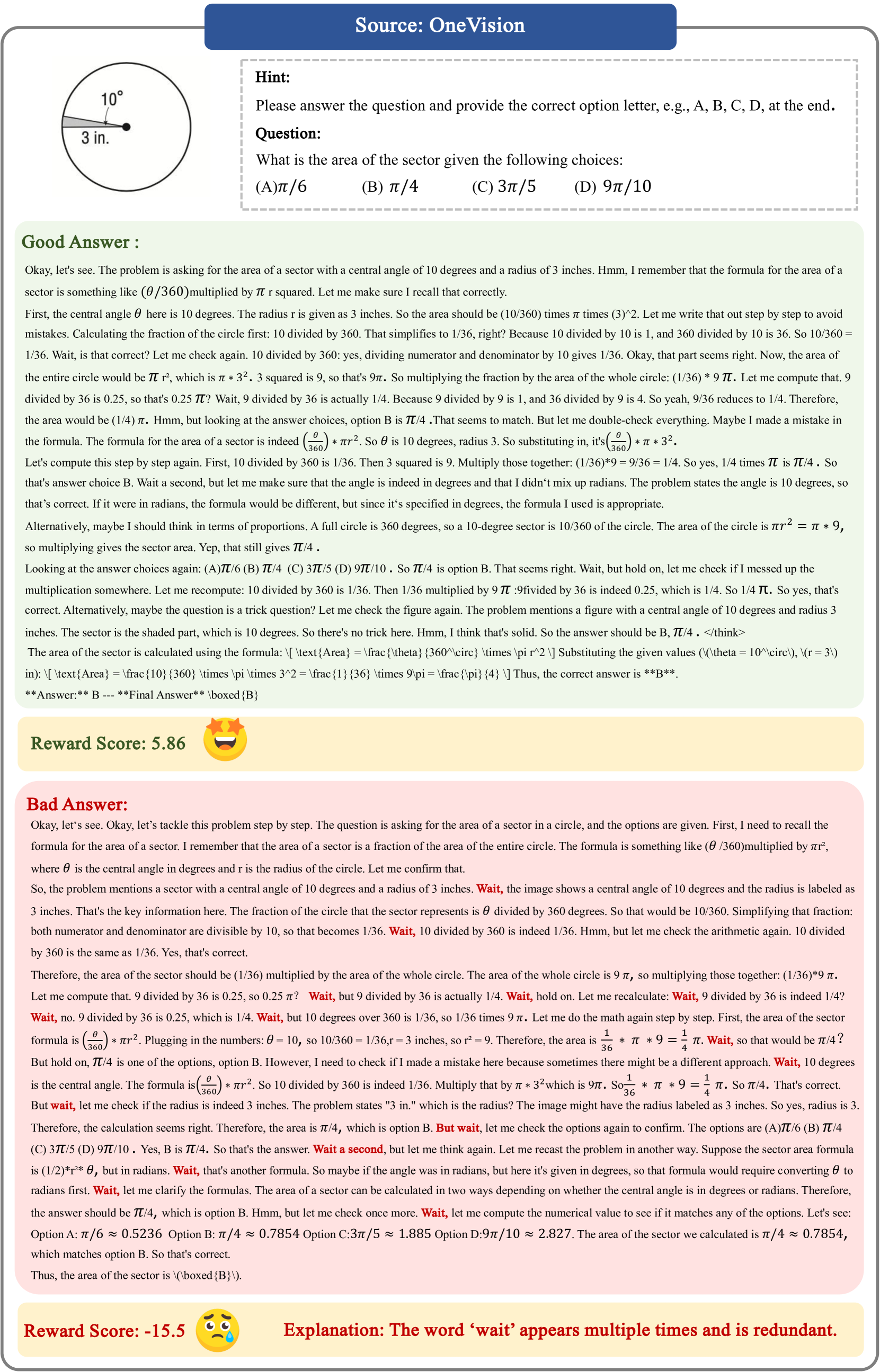
Stage 3(推理数据):自建约 50K 推理偏好数据,涵盖数学(35.4%)、物理(24.6%)、化学(20.2%)、生物(14.7%)等领域,两种生成方式:
- 直接生成(47.4%):使用 Skywork R1V 推理模型
- 两步生成(52.6%):标准 VLM 描述 → Deepseek R1 推理
最终数据集 ~190K 偏好对,其中 ~70% 包含图像。
模型架构
基于 Qwen2.5-VL-7B-Instruct,修改如下:
- 视觉编码器(ViT):冻结
- 投影器 + 语言骨干:可训练
- 奖励头:将 causal LM head 替换为全连接层,输出最后隐藏状态对应的标量奖励分数
训练策略
两阶段微调:
| 阶段 | 数据 | 学习率 | 轮数 |
|---|---|---|---|
| Stage 1 | 仅多模态偏好数据 | 1e-5 | 2 |
| Stage 2 | 多模态 + 文本混合数据 | 1e-6 | 2 |
优化器:AdamW
损失函数:标准 pairwise ranking loss(与 Skywork-Reward 一致):
其中 为 sigmoid 函数, 为奖励模型输出, / 分别为 chosen / rejected 响应。
关键结果
VL-RewardBench(Table 3)
| 模型 | Size | General | Hallucination | Reasoning | Overall | Macro Avg |
|---|---|---|---|---|---|---|
| GPT-4o | - | 49.1 | 67.6 | 70.5 | 65.8 | 62.4 |
| Gemini-2.0-flash-exp | - | 50.8 | 72.6 | 70.1 | 68.8 | 64.5 |
| IXC-2.5-Reward-7B | 7B | 80.3 | 65.3 | 60.4 | 66.3 | 68.6 |
| InternVL3-8B | 8B | 60.6 | 44.0 | 62.3 | 57.0 | 55.6 |
| InternVL3-78B | 78B | 67.8 | 52.5 | 64.5 | 63.3 | 61.6 |
| Skywork-VL Reward | 7B | 66.0 | 80.0 | 61.0 | 73.1 | 69.0 |
Skywork-VL Reward 以 7B 参数量取得 73.1% 的 Overall Accuracy,超越所有闭源模型和开源模型,其中 Hallucination 维度高达 80.0%,领先所有对手。
RewardBench(Table 4,纯文本)
| 模型 | Chat | Chat Hard | Safety | Reasoning | Avg |
|---|---|---|---|---|---|
| Skywork-Reward-Llama3.1-8B-v0.2 | 94.7 | 88.4 | 92.7 | 96.7 | 93.1 |
| QRM-Llama3.1-8B-v2 | 96.4 | 86.8 | 92.6 | 96.8 | 93.1 |
| IXC-2.5-Reward-7B | 90.8 | 83.8 | 87.8 | 90.0 | 88.1 |
| Skywork-VL Reward | 90.0 | 87.5 | 91.1 | 91.8 | 90.1 |
在纯文本 RewardBench 上,Skywork-VL Reward(90.1)大幅超越其他多模态 RM(IXC-2.5-Reward 88.1),接近专用文本 RM(93.1),展示了良好的跨模态泛化能力。
MPO 下游应用(Table 5)
| 模型 | MathVista (%) |
|---|---|
| Qwen2.5-VL-7B(基线) | 69.2 |
| + InternVL3-8B 构建偏好 | 71.2 |
| + Skywork-VL Reward 构建偏好 | 71.8 |
| + Skywork-VL Reward for MPO | 73.5 |
使用 Skywork-VL Reward 构建的偏好数据进行 MPO 训练,在 MathVista 上获得 +4.3% 的绝对提升。
总结性评价
Skywork-VL Reward 是 Skywork-Reward 向多模态领域的自然延伸,延续了其数据中心的方法论。几个关键观察:
- 数据构建是核心:三阶段数据流水线(过滤 → 增强 → 推理补充)是其成功的关键,特别是自建的 50K 推理数据覆盖了 STEM 领域的薄弱环节
- 两阶段训练有效:先多模态后混合的策略避免了文本能力退化,同时保持了跨模态的泛化
- Hallucination 检测突出:80.0% 的幻觉检测准确率远超其他模型,可能得益于高质量多模态偏好数据中对幻觉的充分覆盖
- MPO 应用价值明确:作为 reward model 不仅能评估,还能通过 MPO 显著提升下游推理能力,形成闭环
- 局限性:仅 7B 参数,Reasoning 维度(61.0%)相比 GPT-4o(70.5%)仍有差距;论文缺少详细的 ablation 研究
🔗 相关论文
基于/改进自: Skywork-Reward
同方向: VL-RewardBench, UnifiedReward