RewardDance
📌 核心贡献
首次提出视觉生成领域的统一生成式 RM 框架,将 reward scoring 重新表述为 VLM 预测 “yes” token 的概率,与 next-token prediction 原生对齐,并通过模型规模(1B→26B)+ 上下文丰富度的双维度 scaling 实现性能提升和 reward hacking 抵抗。
📖 摘要
We present RewardDance, a novel framework that treats reward scoring as the model’s probability of predicting a “yes” token, indicating that the generated image outperforms a reference image. This approach aligns reward mechanisms with Vision-Language Model architectures. The framework scales reward models along two dimensions: model scaling (up to 26 billion parameters) and context scaling (incorporating task-specific instructions, reference examples, and chain-of-thought reasoning). Large-scale models maintain high reward variance during training, resisting reward hacking and reducing mode collapse. RewardDance demonstrates improvements across text-to-image, text-to-video, and image-to-video generation tasks.
🔍 关键信息
| 字段 | 内容 |
|---|---|
| 机构 | ByteDance Seed |
| 发表 | 2025-09-10 |
| 分类 | cs.CV, cs.LG |
| 链接 | arXiv |
📝 我的笔记
方法总览
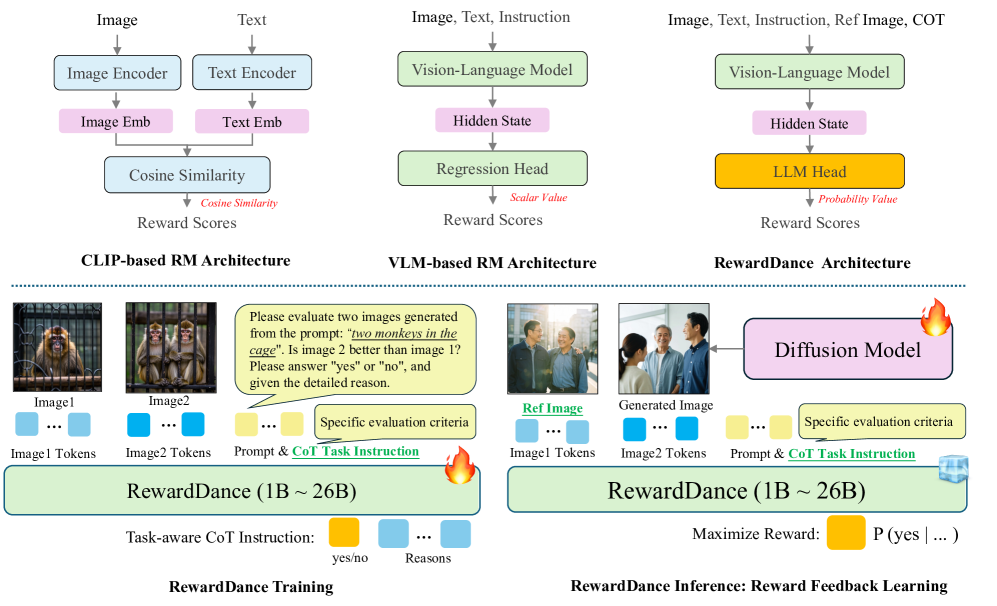
核心问题/动机
现有视觉生成的 Reward Model 存在根本性缺陷:
- CLIP-based RM:受限于双编码器架构和单模态设计,难以扩展
- VLM-based 回归 RM:使用 Bradley-Terry loss + 回归头,与模型原生的 next-token prediction 范式不匹配
- Reward Hacking:模型利用奖励信号的缺陷获取高分,而非真正提升质量,导致 mode collapse
核心洞察:视觉生成领域的 RM scaling 范式尚未被充分探索。
方法
1. Generative Reward Paradigm(核心创新)
抛弃回归头,将 reward scoring 重新表述为 token 生成任务:
- = 被比较的图像 tokens
- = prompt
- = task-aware instruction
- 奖励 = VLM 预测 “yes” token 的概率(即生成图像优于参考图像的概率)
这使得 reward 目标与 VLM 的自回归 next-token prediction 机制原生对齐。
2. 两维度 Scaling
Model Scaling:基于 InternVL 架构,从 1B 扩展到 26B 参数。更大的 RM 在训练过程中保持更大的 reward 方差,表明持续探索,抵抗 reward hacking。
Context Scaling:丰富输入上下文:
- Task-aware instructions:基于预定义标准引导评估
- Reference images:通过 Best-of-N 采样策略实现图像对比较
- Chain-of-Thought (CoT) reasoning:模型生成决策理由,提升可解释性和性能
3. 训练变体
- Pairwise Generative(主要):需要参考图像,用 Bradley-Terry loss 在偏好对上训练
- Pointwise Generative:仅接受 prompt + 生成图像,使用 BT loss + 加权交叉熵 loss(对 preferred samples 赋 “yes” 标签)
4. Reward Feedback Alignment
- RL Fine-tuning:采用 ReFL 算法,Best-of-N 采样生成候选图像,pairwise 比较找到最优参考
- Inference-Time Scaling:Search over Paths — 初始化 N 条采样轨迹,在每个 ODE 采样步用轻量 pointwise RM 剪枝搜索空间
关键结果
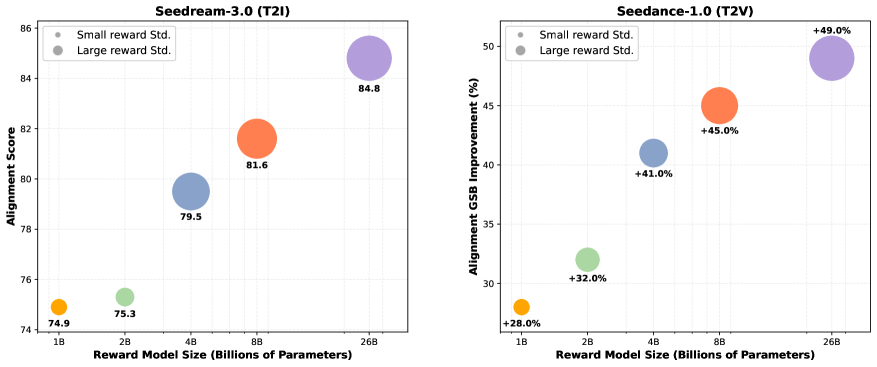
| 任务 | 基线 | + 26B RM | 提升 |
|---|---|---|---|
| FLUX.1-dev 图文对齐 | 67.0 | 73.6 | +6.6 |
| Seedance T2V (GSB) | baseline | +49% | 显著 |
| GenEval | SD3: 0.74 | Seedream-3.0: 0.79 | +0.05 |
| Bench-240 | Imagen 3: 0.79 | Seedream-3.0: 0.848 | +0.058 |
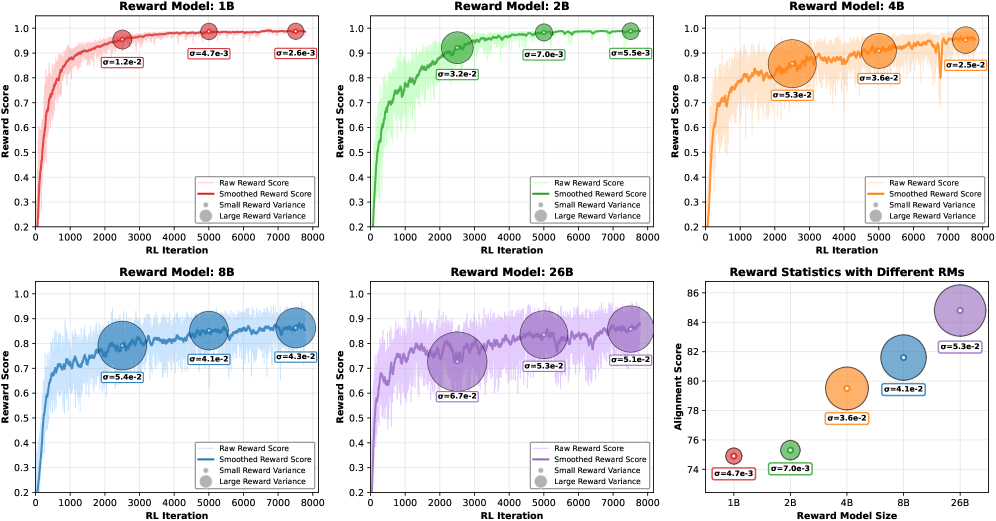
关键发现:
- OOD accuracy 比 ID accuracy 更能预测最终 RL 性能
- 26B RM 训练全程保持高方差,1B-2B RM 快速收敛
- CoT 训练带来 +2.0 对齐分提升 (81.6→83.6)
Ablation
| 组件 | 影响 (FLUX) |
|---|---|
| 回归→生成范式 | 70.8 → 71.6 |
| 加入参考图像 (pairwise) | 71.6 → 73.0 |
| CoT 训练 | 81.6 → 83.6 (Seedream) |
总结
核心贡献在于将 reward scoring 与 VLM 的 next-token prediction 原生对齐,避免范式不匹配问题。大模型(26B)天然抵抗 reward hacking,是一种 elegant 的 scaling 方案。
🔗 相关论文
基于/改进自: ImageReward
同方向(reward model): SoliReward