MMRB2
📌 核心贡献
提出首个面向多模态理解与交错生成的综合性奖励模型基准 MMRB2,涵盖 4 类任务、4,000 个专家标注偏好对,系统评估了 23 个 SOTA 模型,揭示当前最强 AI 判官(Gemini 3 Pro ~76%)与人类(>90%)之间的显著差距。
📖 摘要
Reward models (RMs) are essential for training large language models (LLMs), but remain underexplored for omni models that handle interleaved image and text sequences. We introduce Multimodal RewardBench 2 (MMRB2), the first comprehensive benchmark for reward models on multimodal understanding and (interleaved) generation. MMRB2 spans four tasks: text-to-image, image editing, interleaved generation, and multimodal reasoning (“thinking-with-images”), providing 1,000 expert-annotated preference pairs per task from 23 models and agents across 21 source tasks. MMRB2 is designed with: (1) practical but challenging prompts; (2) responses from state-of-the-art models and agents; and (3) preference pairs with strong human-expert consensus, curated via an ensemble filtering strategy. Using MMRB2, we study existing judges for each subtask, including multimodal LLM-as-a-judge and models trained with human preferences. The latest Gemini 3 Pro attains 75-80% accuracy. GPT-5 and Gemini 2.5 Pro reach 66-75% accuracy, compared to >90% for humans, yet surpass the widely used GPT-4o (59%). The best performing open-source model Qwen3-VL-32B achieves similar accuracies as Gemini 2.5 Flash (64%). We also show that MMRB2 performance strongly correlates with downstream task success using Best-of-N sampling and conduct an in-depth analysis that shows key areas to improve the reward models going forward.
🔍 关键信息
📝 我的笔记
方法总览
核心问题/动机
当前奖励模型(RM)的研究主要集中在纯文本领域,对于处理交错图文序列的全模态模型(omni models)的评估严重不足。已有的多模态评估基准存在以下问题:
- 任务覆盖不全:缺少对图像编辑、交错生成、多模态推理等任务的评估
- 难度不足:传统指标(如 CLIPScore、ImageReward)在简单 prompt 上尚可工作,但在复杂 prompt 上已不可靠
- 质量控制不够:缺乏强人类共识的高质量偏好标注
基准设计
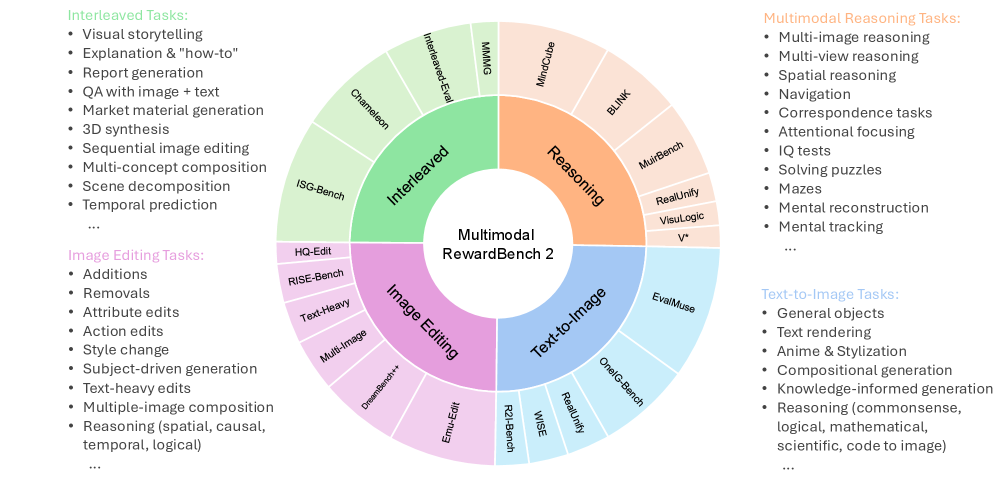
四大任务类别
| 任务 | 输入 | 输出 | 关注点 | 数据源数量 |
|---|---|---|---|---|
| Text-to-Image | 文本 prompt | 生成图像 | 组合、空间关系、属性绑定、文字渲染 | 5 个 |
| Image Editing | 1-3 张图 + 编辑指令 | 编辑后图像 | 指令忠实度、区域保持、多图合成 | 5 个 |
| Interleaved Generation | 多模态 prompt | 图文交错序列 | 连贯性、全局规划、视觉-文本协调 | 4 个 |
| Multimodal Reasoning | 复杂推理问题 | 推理轨迹(文本/图像) | 视觉理解、逻辑推断、多步推理 | 6 个 |
每个任务 1,000 个偏好对,共 4,000 个,来自 21 个源数据集。
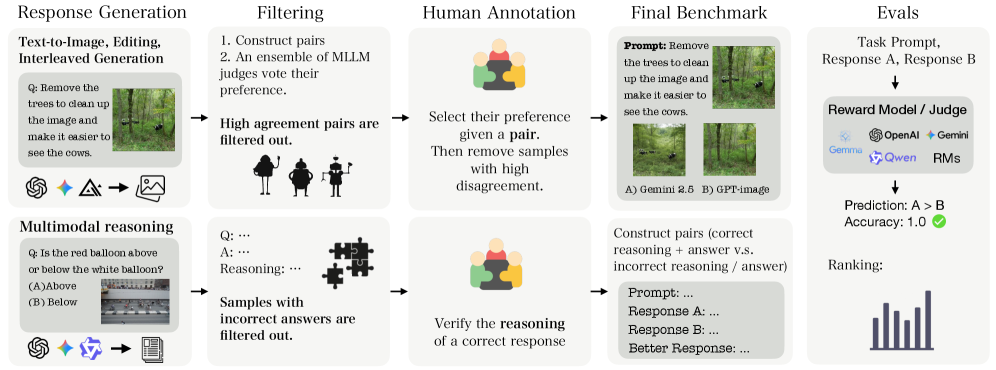
数据构建流程
1. Prompt 收集:从 21 个已有 benchmark 中分层采样,按覆盖度和难度加权。
2. Response 生成:每个 prompt 用 7-11 个 SOTA 模型生成多个 response:
- 生成类任务:Gemini 2.0/2.5 Flash Image, Imagen 3/4/Ultra, FLUX, GPT-Image-1, SD 3.5-L 等
- 交错/推理任务:构建专用 Agent(Python + 图像生成/编辑工具)
3. 集成过滤(Ensemble Filtering):
- 9 个多模态判官(GPT-5, GPT-4.1, GPT-4o, Gemini 2.5 Flash/Pro, Gemma-3, Qwen-2.5-VL 等)
- 每对样本评估 2 次(位置互换,消除位置偏差)
- 判官一致性 >90% 的”简单对”被丢弃,保留有信息量的挑战样本
4. 人类专家标注:
- 通过 Surge AI 招募专业标注员($85/小时)
- 每对 3 名独立标注员,7 分 Likert 量表评估忠实度、质量、对齐度
- 过滤掉标注员评分跨度 >4 分或均值落在 3.0-4.0(模糊区间)的样本
5. 质量指标:最终过滤后的数据集标注员间一致性达 95.6%(生成 95.3%,编辑 96.3%,交错 95.2%)。
关键结果
MLLM-as-a-Judge 准确率
| 判官模型 | T2I | Editing | Interleaved | Reasoning | 平均 |
|---|---|---|---|---|---|
| 闭源 API | |||||
| Gemini 3 Pro | 74.4 | 74.9 | 76.4 | 79.5 | 76.3 |
| GPT-5 | 70.5 | 73.8 | 74.4 | 70.2 | 72.2 |
| Gemini 2.5 Pro | 70.5 | 71.3 | 75.1 | 66.6 | 70.9 |
| GPT-4.1 | 65.8 | 68.2 | 67.0 | 53.0 | 63.5 |
| Gemini 2.5 Flash | 63.1 | 66.5 | 69.4 | 57.5 | 64.1 |
| GPT-4o | 60.3 | 65.0 | 61.5 | 51.9 | 59.7 |
| 开源 | |||||
| Qwen3-VL-32B | 64.1 | 67.3 | 70.5 | 56.6 | 64.6 |
| Qwen3-VL-235BA22B | 62.0 | 64.8 | 69.0 | 55.9 | 62.9 |
| Qwen3-VL-8B | 59.4 | 61.7 | 61.5 | 54.6 | 59.3 |
| Qwen2.5-VL-72B | 59.1 | 64.6 | 62.3 | 50.0 | 59.0 |
| Gemma 3 27B | 58.3 | 60.2 | 61.1 | 49.4 | 57.3 |
| Gemma 3 12B | 56.0 | 58.0 | 58.0 | 49.3 | 55.3 |
| Gemma 3 4B | 51.7 | 51.0 | 51.3 | 48.8 | 50.7 |
核心发现:
- 人类 vs AI 差距显著:人类准确率 >90%,最强 AI(Gemini 3 Pro)仅 76.3%
- GPT-4o 已过时:59.7% 的准确率表明它”不再适合评估前沿多模态模型”
- 最强开源模型 Qwen3-VL-32B (64.6%) 与 Gemini 2.5 Flash (64.1%) 相当
监督式奖励模型对比
| 模型 | T2I | Editing* | Reasoning* |
|---|---|---|---|
| PickScore | 58.6 | — | — |
| HPSv3 | 60.2 | — | — |
| UnifiedReward | 59.8 | — | 55.1 |
| EditReward | — | 67.2 | — |
| CLIPScore | 51.0 | — | — |
| ImageReward | 54.0 | — | — |
| HPSv2 | 54.7 | — | — |
*Editing 为单图子集;Reasoning 为纯文本输出子集
关键发现:传统任务特定指标(VQAScore 58.3%、ImageReward 54.0%)已大幅落后于 MLLM 判官,表明它们在复杂 prompt 上不再可靠。
同模型 vs 跨模型判别
| 任务 | 判官 | 总体 | 同模型对 | 跨模型对 |
|---|---|---|---|---|
| Image Generation | Gemini 3 Pro | 74.4% | 70.4% | 79.7% |
| Image Editing | Gemini 3 Pro | 74.9% | 71.0% | 79.3% |
| Interleaved | Gemini 3 Pro | 76.4% | 72.8% | 82.0% |
跨模型对的准确率比同模型对高 5-13 个百分点,说明对同一模型的细粒度质量判别仍然具有挑战性。
下游任务相关性
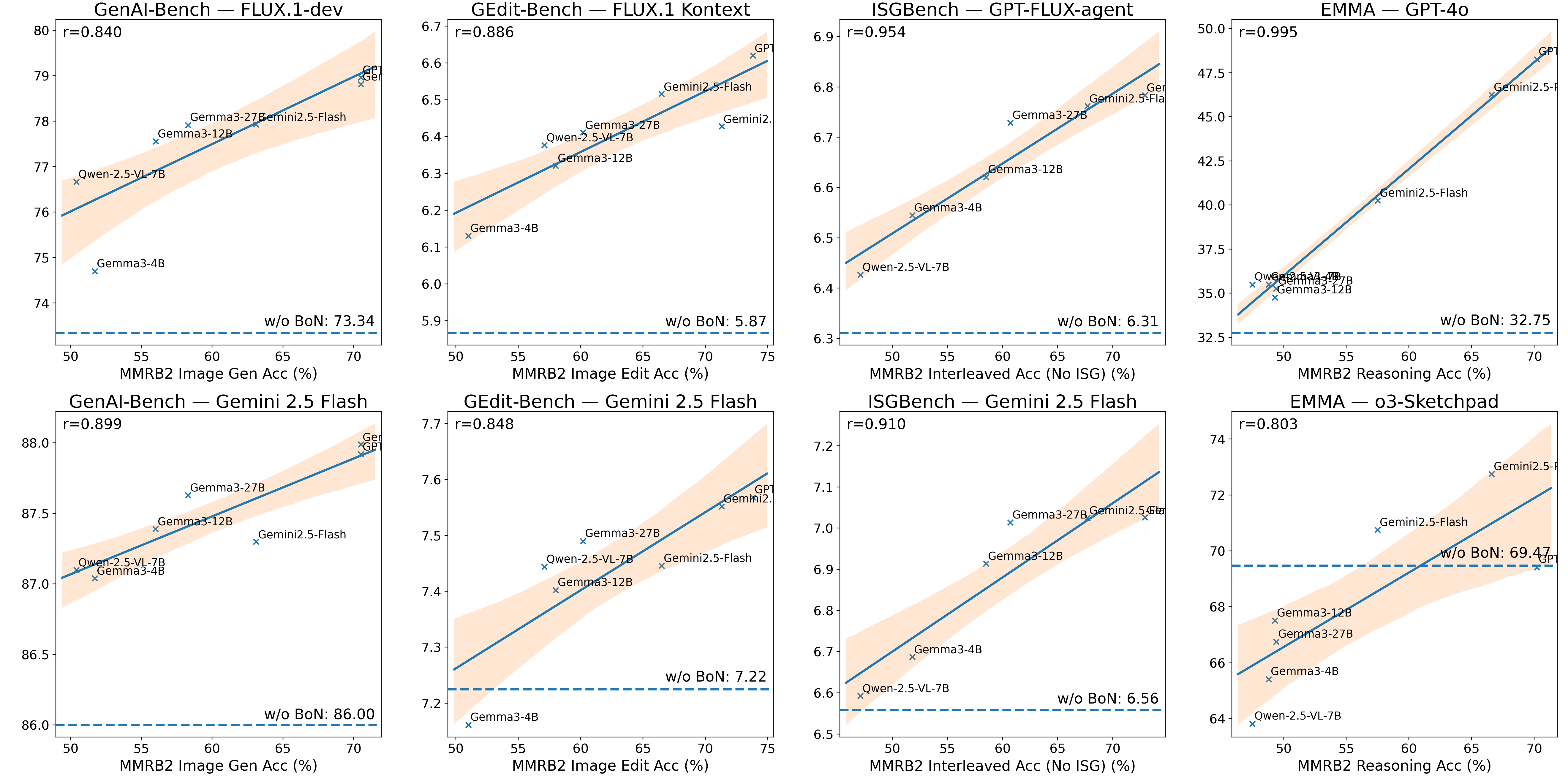
MMRB2 分数与下游 Best-of-N 采样成功率之间存在强相关性(Pearson r > 0.8),验证了该基准的实用价值。测试涵盖 GenAI-Bench、GEdit-Bench、ISG-Bench 和 EMMA 四个下游任务。
深入分析
图像偏差问题
在混合模态推理对中,判官对包含图像的回答存在强烈偏好偏差:偏好含图像 response vs 偏好纯文本 response 的性能差距达 27.7-49.3 个百分点。
Test-Time Scaling 受限
与文本模型不同,多模态奖励模型从多数投票中获益极小:K=9 时仅提升 0.8-1.2%,远低于纯文本 LLM 基准。
生成模型排名
| 任务 | 排名 | 模型 | 胜率 |
|---|---|---|---|
| T2I | 1 | GPT-Image-1 | 60.4% |
| T2I | 2 | Imagen 4 | 57.4% |
| T2I | 3 | Imagen 4 Ultra | 56.5% |
| Editing | 1 | Gemini 2.5 Flash | 59.2% |
| Editing | 2 | GPT-Image-1 | 53.2% |
| Interleaved | 1 | GPT-Gemini Agent | 57.1% |
| Interleaved | 2 | GPT-Image Agent | 56.9% |
总结
MMRB2 填补了多模态奖励模型评估的重要空白。几个值得关注的发现:
- 传统指标的淘汰:CLIPScore、ImageReward、HPSv2 等在复杂 prompt 上表现接近随机,VLM-based 判官(如 MLLM-as-a-Judge)已成为更可靠的替代方案
- 推理能力是瓶颈:多模态推理任务(thinking-with-images)是所有模型最薄弱的环节,即使 Gemini 3 Pro 也仅 79.5%
- 图像偏差值得警惕:判官倾向于偏好包含图像的回答,即使纯文本回答质量更高,这在 RLHF 训练中可能引入系统性偏差
- 基准设计范例:MMRB2 的集成过滤 + 人类验证的两阶段流程是构建高质量偏好数据集的良好范式
🔗 相关论文
同方向: UnifiedReward, UnifiedReward-Flex, ImageReward, HPSv2, HPSv3, PickScore, VisionReward